

This type of satin stitch is used to cover a larger area of the pattern. This allows smaller and tighter satin stitches to be used instead of long and saggy ones. The pattern is broken up into smaller horizontal or vertical sections. Then, each section, at a time, is covered with satin stitch. The important thing to remember is that the satin stitch in the next row will always begin from between the two stitches from the previous row. This kind of stitch can be used wonderfully with threads of different shades.
You need to know the satin stitch to be able to do this stitch. I will work on a leaf pattern.
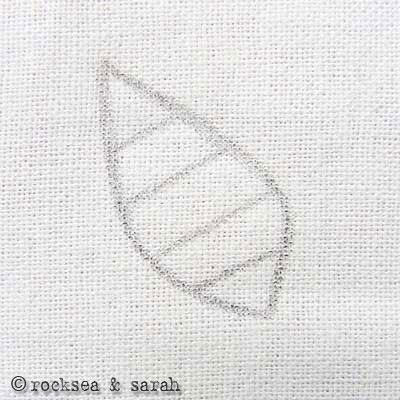 | 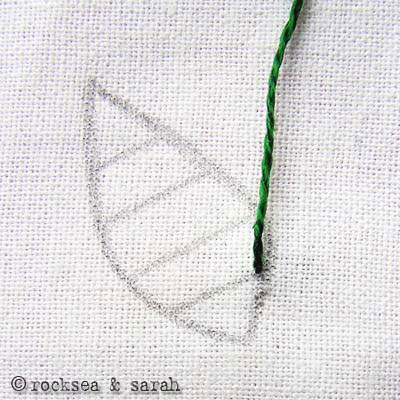 |
| Fig 1: I first divide the leaf pattern into sections. I have done 4 sections. This is to aid your stitching and also this tutorial. But, once you learn this stitch, making such sections is only a choice of convenience. | Fig 2: Bring the needle out from the edge of the first stitch line as in the illustration. Every stitch will be done straight. |
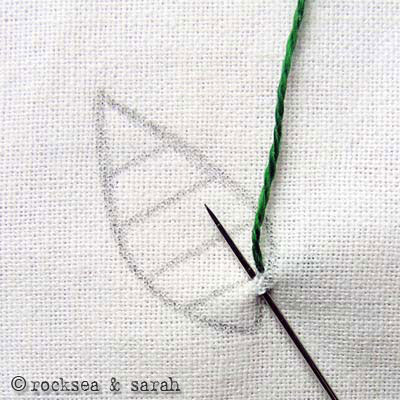 | 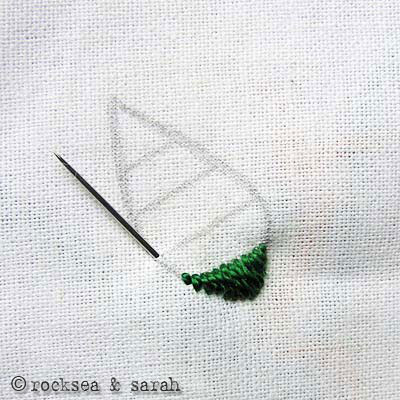 |
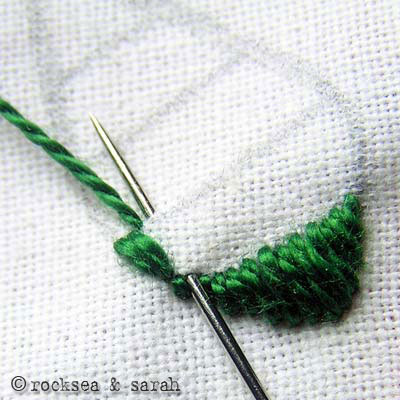
| Fig 3: Now, start doing the satin stitch to fill in the first section of the leaf. Such smaller satin stitches are more durable and good to look at. | Fig 4: Once you finish one section, it will look like this. Continue and bring the needle out from the second stitch line to fill the second section. |
 | 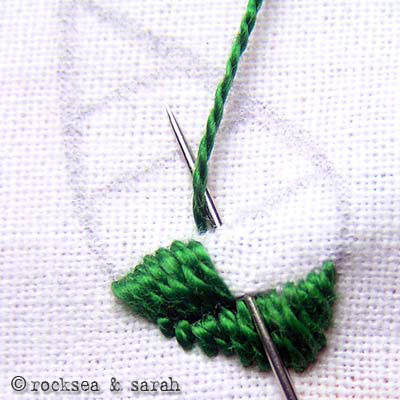 |
| Fig 5: You continue to fill up the next section with satin stitch as well. The only thing to be careful about is to set the stitches between two stitches of the previous section. See the illustration. | Fig 6: You continue the procedure of ‘encroaching’ between the stitches of the previous sections where they share the same stitch line. This is what gives the stitch its name. |
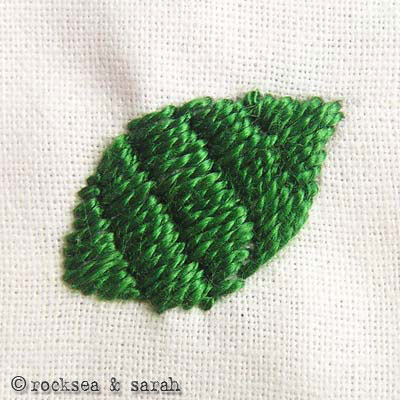 | |
| Fig 7: A finished pattern of leaf will look like this. If you click on the image, you will get a zoomed version where you can probably make out the ‘encroachments’. |
Learn to do Encroaching Satin Stitch in 2 minutes!
Use this stitch on a pattern
Visit and Subscribe to Sarah’s YouTube Channel
Learn this stitch along with 305 other stitches from our 600-page eBook.
Other stitches from the Satin Stitch Family
Surface Satin |
Back Stitched Satin | |
Trailing Stitch |
Double Satin |






I haven’t hear from you for a while. Hope all is OK. I am sendin a picture o my latest embroidery * of a fox and flowers. This one took a while. I made lots of very time flowe4rs. HAVE A GREAT EAY. SENDING LOVE AND HUGS FOR ALL…………….❤️❤️❤️❤️❤️
Hello! I was just wondering if it would be possible to combine this with surface satin stitch? Just thought I’d check with the expert before potentially losing time 😉
Hi Ioana,
That is a fantastic idea! I have never tried it myself yet, but I don’t see why it should not work. 👍🏼😁 Go ahead and try it.
can’t we do this stitch with normal sewing thread?
This thread is not as thick as it looks. A normal sewing yarn would be too thin to do this stitch. You will understand this when you try stitching. The thicker the thread, the easier it is to fill and better to see.
is it necessary to do this stitch with a thick thread?
can’t we do it with normal sewing thread?
Dear Jenessa,
This thread is not as thick as it looks. 🙂 A normal sewing yarn would be too thin to do this stitch. You will understand this when you try stitching. The thicker the thread, the easier it is to fill and better to see.
Thankz a lot Sarah
But I want to know that does it make any damage to the fabric?
And I think it wl be nice if the lines[partition]wl be horizontal
Dear Safia,
This stitch shoudl not damage any fabric!
You can always experiment with horizontal partition…and maybe even share your attempt with us. 🙂
Thankz a lot Sarah
But I want to know that does it make any damage to the fabric?
dear sarah.
very very thanx sarah.it is very cute to understand.i love it .thanks a lot
hi.. very very thanx.wonder full site.
Thanks Tahereh.
happy to see so much of stitches! New to this field like to learn more
🙂 I hope you enjoy learning from our pages.
Pls i like to subscribe ur blog. How can i do that, can u pls email me
Dear Loveline,
You can subscribe to the embroidery articles using a feed reader (like google reader), with the following url: https://www.embroidery.rocksea.org/feed
ur stitch library is very easy to follow;i learnt many stitches from ur site.can u post any of ur works,even i will post mine.i do lots nd lots of hand works
Dear Nallari,
We feel happy that you were able to benefit well from our pages. Will surely post some of my works as I get a chance to. The embroidery tutorials have some of my original works, which I have used for tutorials.
Hi, in this pattern can we use diff type of colour between alternate layers? and also this pattern is used to fill the flowers.
Dear Ranjitha,
Of course, you can do different colors alternately using this method. In fact, this method can be good for shading.
Yes, you can try this stitch on flowers as well. 🙂
hi encroaching satin stitch is more fantastic than satin stitch
🙂
wonderful, what type of thread u have used for this stich
Dear Darshana,
I have used perle cotton to demonstrate this stitch.
Hai Sarah,
Looks great. Which is the thread and needle used for this stitch?
Jisha
Thanks Jisha. I have used perle cotton to do thi stitch. 🙂
mrs sarah your art is perfect .very thanx
Hi Sarah I was Wondering is this suitable to create a wave?