
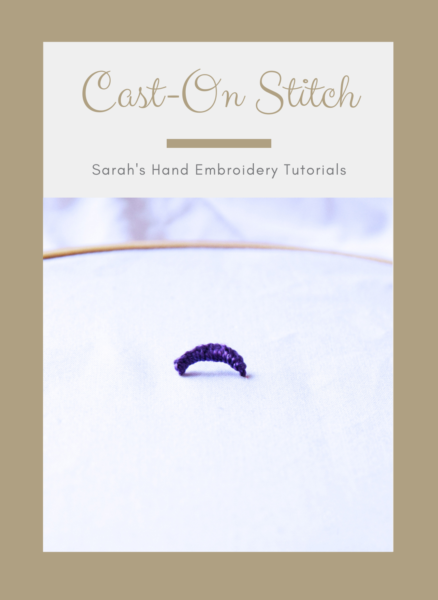
How to do the Cast On Stitch
The Cast On Stitch is a dimensional stitch, commonly used in dimensional embroidery forms. It touches the fabric on both ends and stands free in the middle. This property makes it easy to able to shape the stitch as per the requirement of the project.
 |
 |
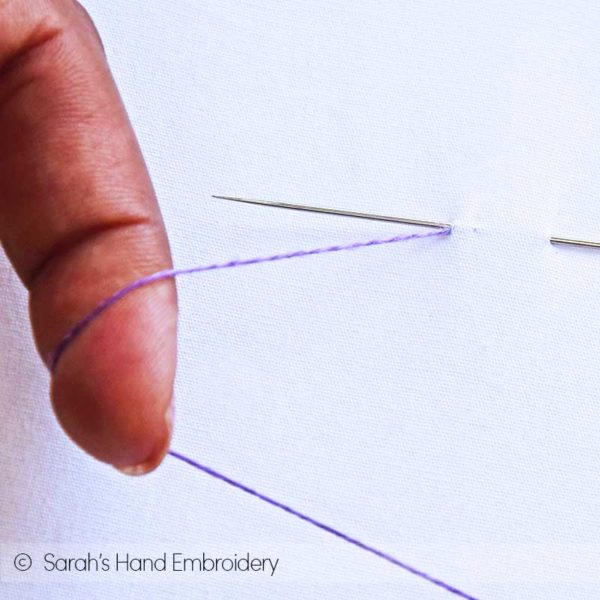
| Fig 1: Bring the needle out from one location. Go in a little back and come out from the first location, as shown. | Fig 2: Place the thread over your finger. |
 |
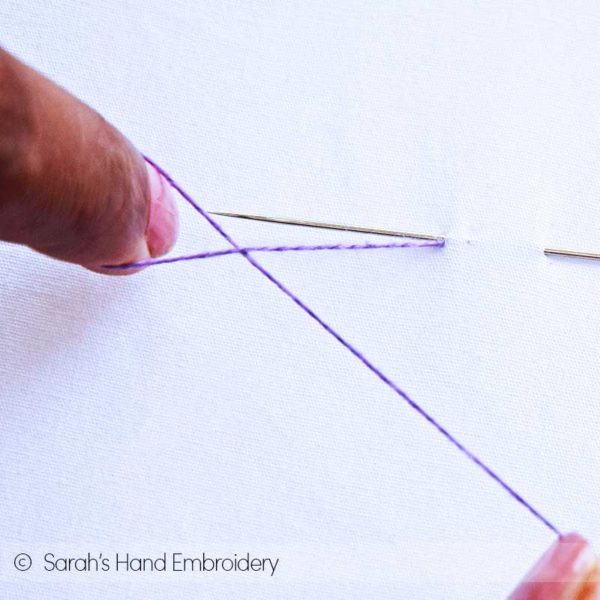 |
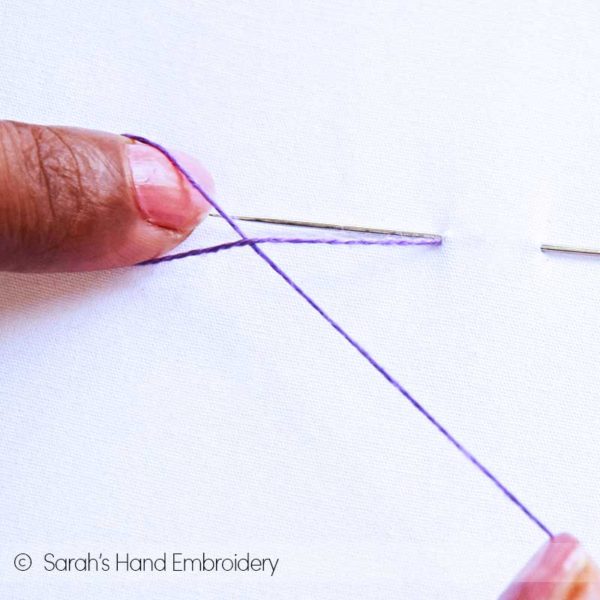
| Fig 3: Twist the thread with your finger. | Fig 4: This creates a twisted loop. |
 |
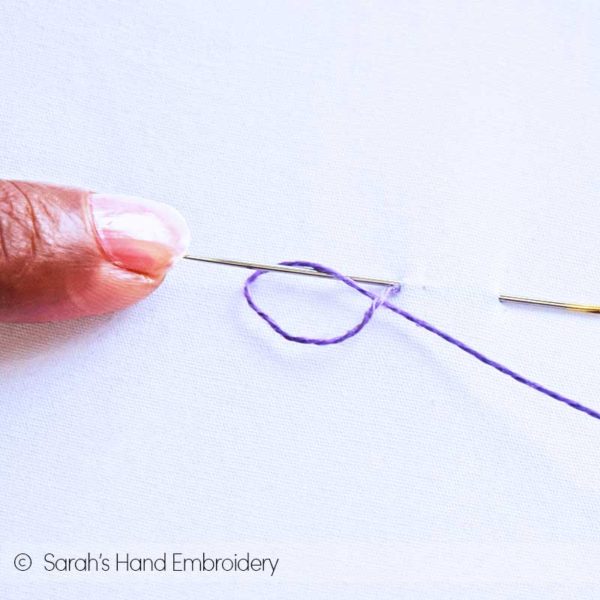 |
| Fig 5: Take it closer to the tip of the needle. Touch the tip of the needle lightly with your index finger and slip the loop onto the needle. | Fig 6: Pull the loop towards the base. |
 |
 |
| Fig 7: Keep making more loops in the same way and build up the wraps on the needle. | Fig 8: The wraps should be at least as much as the space created by the needle. |
 |
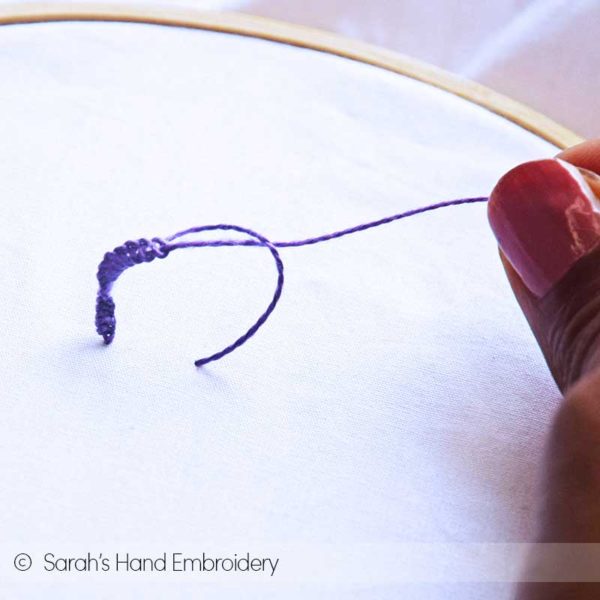 |
| Fig 9: Now, hold the wraps between your fingers and pull out the needle completely. | Fig 10: As you keep pulling the thread, direct it towards the other stitch point. (This is similar to the technique used to make Bullion Knots). |
 |
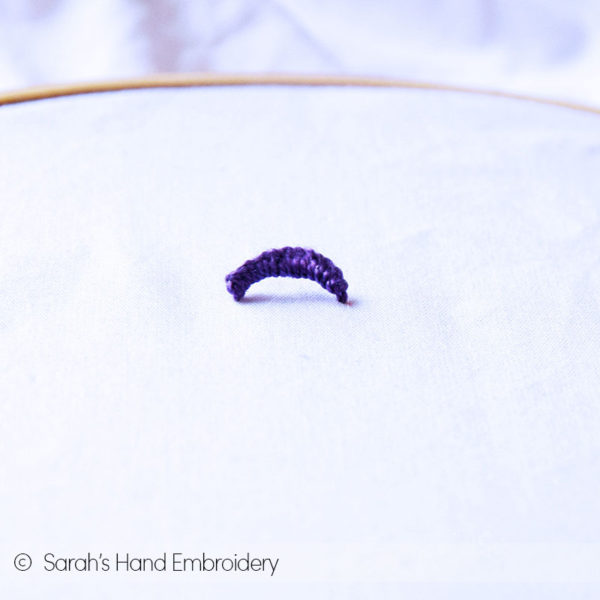 |
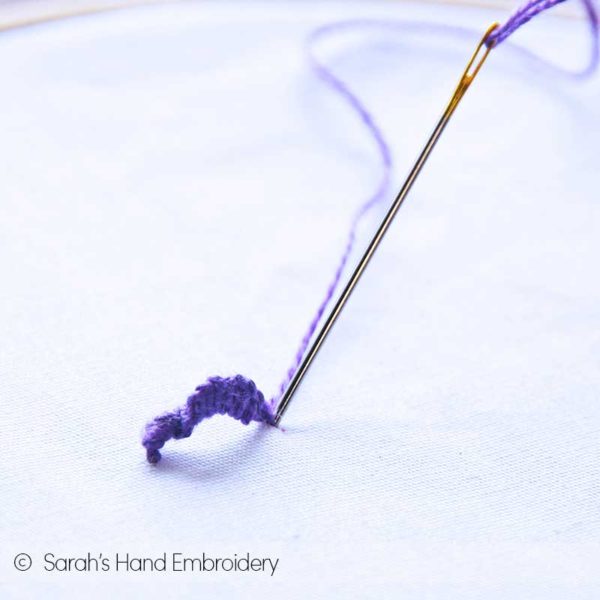
| Fig 11: Take the needle in through the point closer to the earlier stitch point to finish the stitch. | Fig 12: The Cast On Stitch looks like this. Since the wraps are slightly more than the space created by the needle, it takes on a gentle curve. The more the wraps, as against the stitch space made, the sharper the curve will be. |
Learn to do Cast On Stitch in 2 minutes!
Knit Stitch Family
Learn this Stitch and 305 other stitches from our 600-page eBook.
 Sarah has been researching and sharing hand embroidery lessons for over 20 years, making it accessible to everyone around the globe.



Hi, I really love your tutorials. Great work, so first a big THANK YOU!
In my slow stitching group we often discussed that there is no german word for Cast On Stitch. We couldn’t find anything in books or internet. So we decided to call it “Stegstich” – the word “Steg” means little bridge, footbridge, catwalk. It is equivalent to Hardanger embroidery, where a wrapped bar is called “Wickelsteg” and a woven bar is called “Stopfsteg” as it is similar to these stitches. Thought this might be helpful for others, as we sort stitches by name and sometimes it is difficult to handle this in several languages 😉
We really, really appreciate all the work you put in this site and that you have all these stitches named in several languages, this is so helpful and your site is the best one! ❤️❤️❤️❤️
Dear Kitty,
Thank you for droppign by and taking time to appreciate and show love! It is much needed to keep us motivated. ❤️
I am thrilled to learn that you have named the Cast On Stitch in German! 😀 Sometimes, I have tried to name some of the variation stitches too – like the Gut Raincoat Stitch and the Fairy Light Stitch. 🤭You have to when no one have named them yet! With your permission, I would like to add this name to the website in this page. 🙂
XOXO
Sarah
Sure you can use this name. Very happy I could help 🙂
I found an interesting stitch in an old book. The book is really old from 1893… lol I’d love to share but I can’t upload any pictures. Error message says “invalid Referrer” :-((
Thank you so much, Kitty!
Umm..not sure why you are unable to upload the image, but, do you want to try emailign it to me instead- whenever you find the time. 🙂
xoxo
Hi. Sarah’s.
Si sorry I have been v v busy with a lot of work. Now mco again.
Nice work of your. It very interesting to sew it. You are amazing with you work.
Thank you
Ms. Khoo hooi bin.
I hope all is fine there, Ms. Khoo hooi bin. Happy that you are back!
Thanks for the reminder of this stitch, Sarah. I haven’t used it for a long time.
❤️
Thanks for the quick reply. I’ll try manipulating the threads in the future. I’m usually using Perl cotton size 8, so it’s big enough to move around.
I have used Perle cotton 8= equivalent to three strands of embroidery floss. 🙂
My cast on stitches always want to curl. They rarely sit flat on the underneath thread. Would being left handed cause that?
Hi Penny,
It is not uncommon for the stitch to curl. Some stitchers use this nature of the stitch to their advantage.
The kind of thread used and the length of the stitch could matter. What I have figured is that if your thread is thin, or you are using fewer strands as against the length of the stitch, it might have a tendency to curl. Try using 6 strands, then try with 5 and then 4….and see if it makes any difference. Also, the longer the stitch, the more the chances of it twisting.
I don’t think being a left-hander would cause it. Mine almost always has a slight twist. If you check Fig11, it is kind of curling, but I just nudged the ‘knots’ to one side with my fingers and straightened it in Fig12. 😀
hello, maybe it also help. Try leaving thread upside down.