
Woven Spider Wheel is also known as
Woven spider’s wheel, Woven wheel, Woven spider web, Woven rose [EN], Stielstich [DE], Punto ragno [IT], Ponto teia tecida [PT].
How to do the Woven Spider Wheel
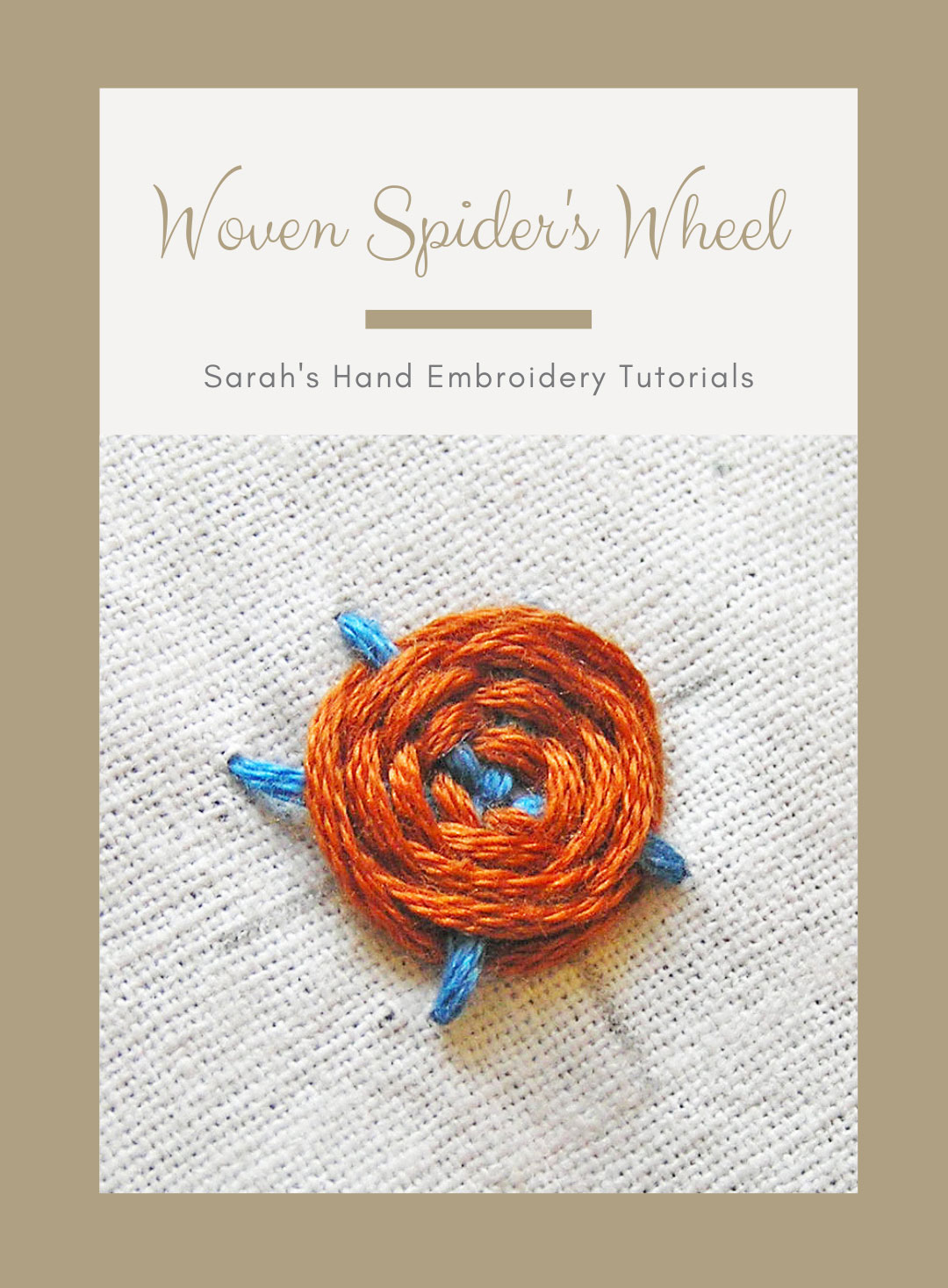
This is a very easy, decorative, and a fascinating stitch. The final effect resembles a spider web, thus, the name. It can be used as an embellishment stitch. I will work between five straight stitches, though more numbers of straight stitches can be used. Just remember to keep odd or uneven numbers of straight stitches. Usually, five or seven straight stitches are preferred. I have not left any space in the center, but you can do so to bring about another effect.
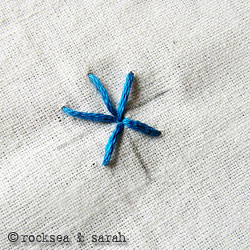 | 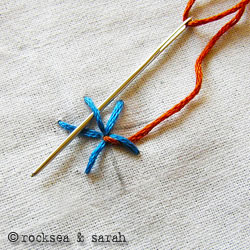 |
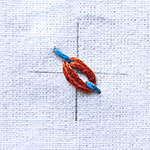
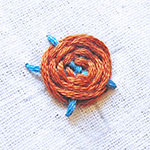
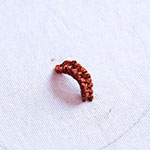
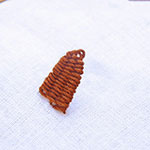
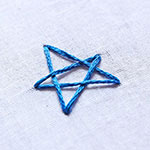
| Fig 1: First, use five Straight Stitches to make a star shape, as shown. | Fig 2: Bring the needle out from the center. Now, start weaving the circle around the straight stitches, by taking the needle under every alternate straight stitch. |
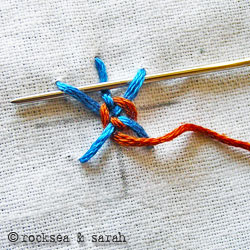 | 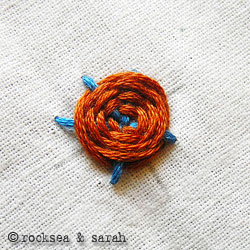 |
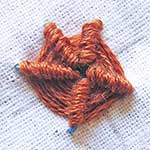
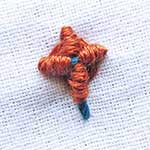
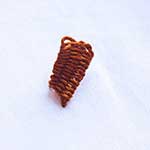
| Fig 3: Keep going around the straight stitches without plucking the fabric underneath. You will notice that you will go above the stitches you went under the last time. | Fig 4: A finished woven spider wheel would look like this. The number of times you want to go around the straight stitches depends on how you want it. Each time, it will give a different effect. Here, I have almost finished going around the straight stitches. |
Learn to do Woven Spider Wheel Stitch in 2 minutes!
Related Projects
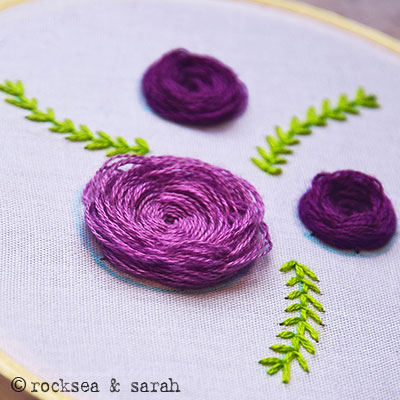
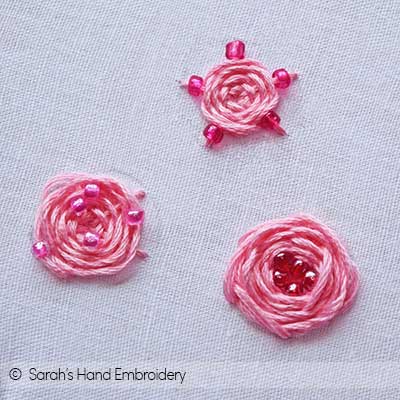
Do you want to know where and how to use this stitch? Check out the projects below and learn more. Make something beautiful!
Learn this stitch along with 305 other stitches from our 600-page eBook.
Other stitches from the Weave Stitch Family
Stripped Woven Band | ||
Raised Needle Wea |
Broad Woven Picot | |
Portuguese Border |






Hi Sarah ,

I loved your simple way of teaching stitches .
god bless your effort .
Hi Najat,
Did you work on this towel using our tutorials!? This is beautiful! Loved it. Thank you for sharing with us.
Hey Sarah! You really helped me. I am just a beginner, and you explain how to do the stitches so easily. The only problem is the thread keeps falling out of the needle and it’s very hard to get it back in. Do you have any suggestions for either of these problems? Thanks!
Hi Willow,
I am happy that you are enjoying our pages. 🙂
If the thread keeps falling out, I would suggest a couple of things:
1. Keep the thread long. Pull open-end longer and closer to the other knotted end. Keep reducing the length as you stitch on. When you get to a point where the thread is short and is falling off the needle, just end the stitch and go for a fresh long thread.
2. Just double your thread. It would mean that you will end up with an even number of strands. So, if you want to work with two strands, just pull out a long strand, put it through the eye, and double it. keep the ends together and knot it. There is no way your thread will fall out! Only worry- it won’t work when you want to use an odd number of strands.
I hope these two quick tips will help.
I noticed that this stitch works well for small flowers.
But for large flowers, the thread starts to bunch up as you make the rounds bigger and bigger.
How do you keep the stitching from bunching up when you get to those larger outside rounds?
Thanks.
Hi Paula,
I can ask you to try either of these two:
1. Make more ‘spokes’. This will make sure that the distance between the straight stitches remain shorter even when the flowers get bigger, keeping the bunching in check. Make sure you have odd number of spokes or straight stitches.
2. Use a thicker thread to weave…like wool.
Then, certain stitches are better when used for smaller patterns. I had once seen a sample where the person had made bigger flowers with this stitch and the bunching actually added to the beauty of the flower. Need not work always though, especially if you are not doing to frame it but on a cloth with some practical purpose. Just let me know if either of these methods worked for you. 🙂
What is the logic or concept behind using uneven lines??
The logic is to keep the stitch sturdy. That is, if you look at eack spoke, you will see that the weaving thread goes up and down alternately, making this stitch possible. If it were even numbered spokes, everytime we go around weaving, we would go up the same spokes, and down the same spokes, whih is quite not what we want.
Hello Sarah,
we love the way you explain embroidery ! We are wondering if you would agree to share your knowledge with the French just by allowing us to copy your pictures and translate your text in French. Of course, there will be a link to your website as the author of the tutorial.
I hope to hearing from you soon,
Audrey
Dear Audrey,
Thanks. 🙂
You may copy our pictures and use it for a translated tutorial with appropriate credentials.
Sorry for a delayed response. Kids and travels kesp us busy.
Dear Sarah,
You have done a wonderful job in this site.
All the stitches are very beautifully explained and shown.
I am very inspired and wish to make a landscape using your intricate stitches to make various patterns.
Kindly suggest which type of cloth is more suitable, dark or light colour to make a landscape piece. I have selected spring season to be embroidered. Please give your suggestion and any other inputs you feel fit.
Thanks again for sharing your wonderful work.
Best regards,
Ritee
Bangalore
Dear Ritee,
Thanks. 🙂
I am happy to know that you will be making a spring landscape. Hope you will share it with us.
I can suggest and bright colors for your spring project. Say, green, peach, yellow or even blue. Pastel colors can also work nice if you use bright threads. White would also be nice and safe to use.
Hope this helped.
Season’s greetings.
This stitch is even prettier when done with ribbon. Use matching floss for the spokes and then weave a thin piece of ribbon through the spokes. Comes out looking like a beautiful rose.
Dear IrishSoonerMom,
Thanks for the lovely suggestion and idea. I will try it sometime soon. 🙂
The spider wheel looks beautiful!! Will you stitch it on my tshirt? 🙂
🙂 yes yes!