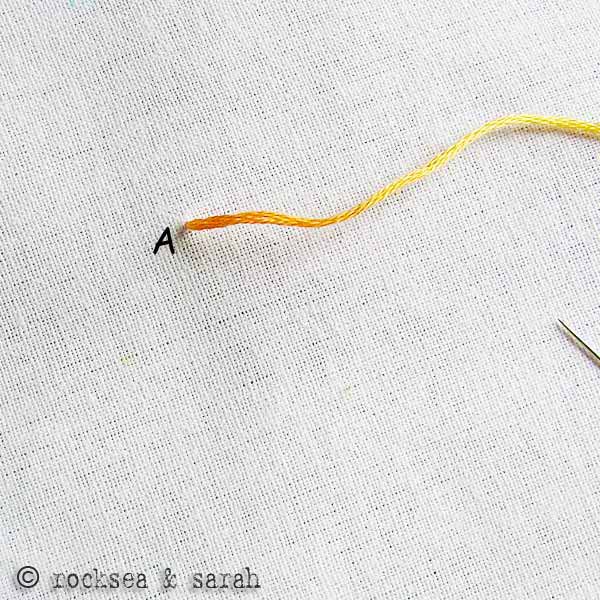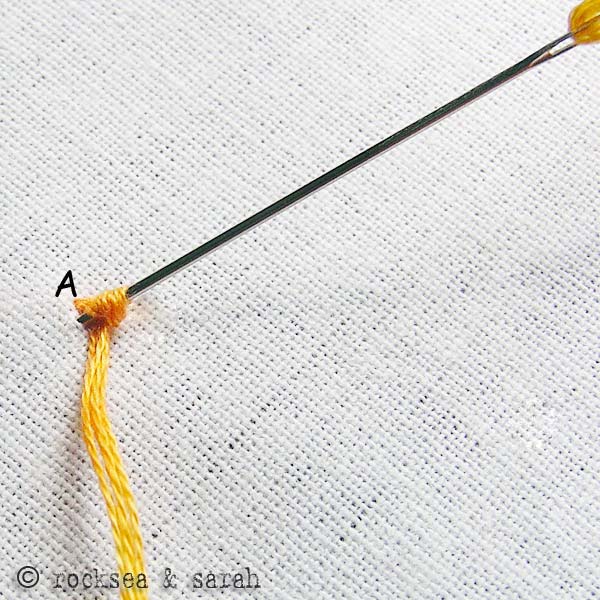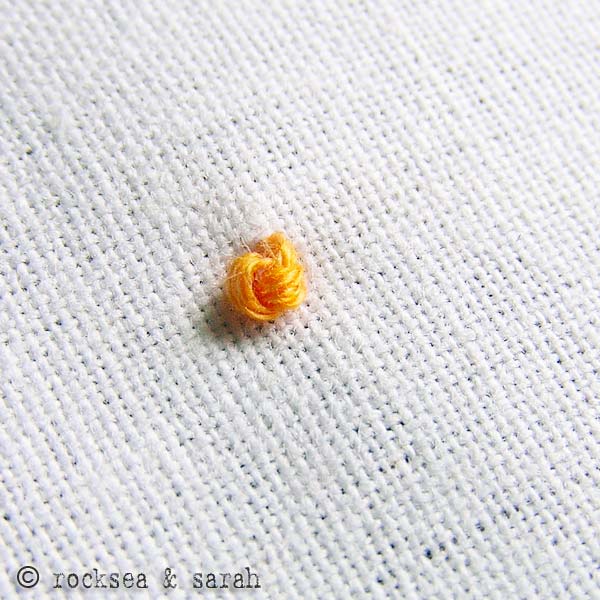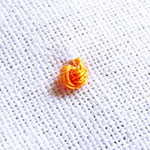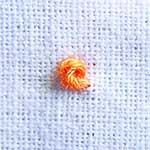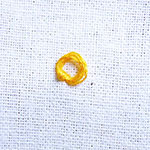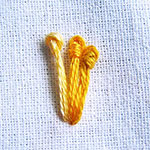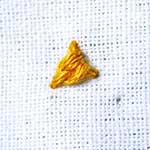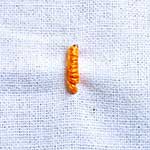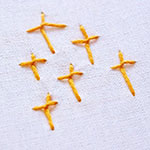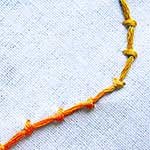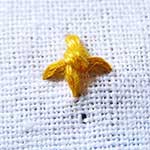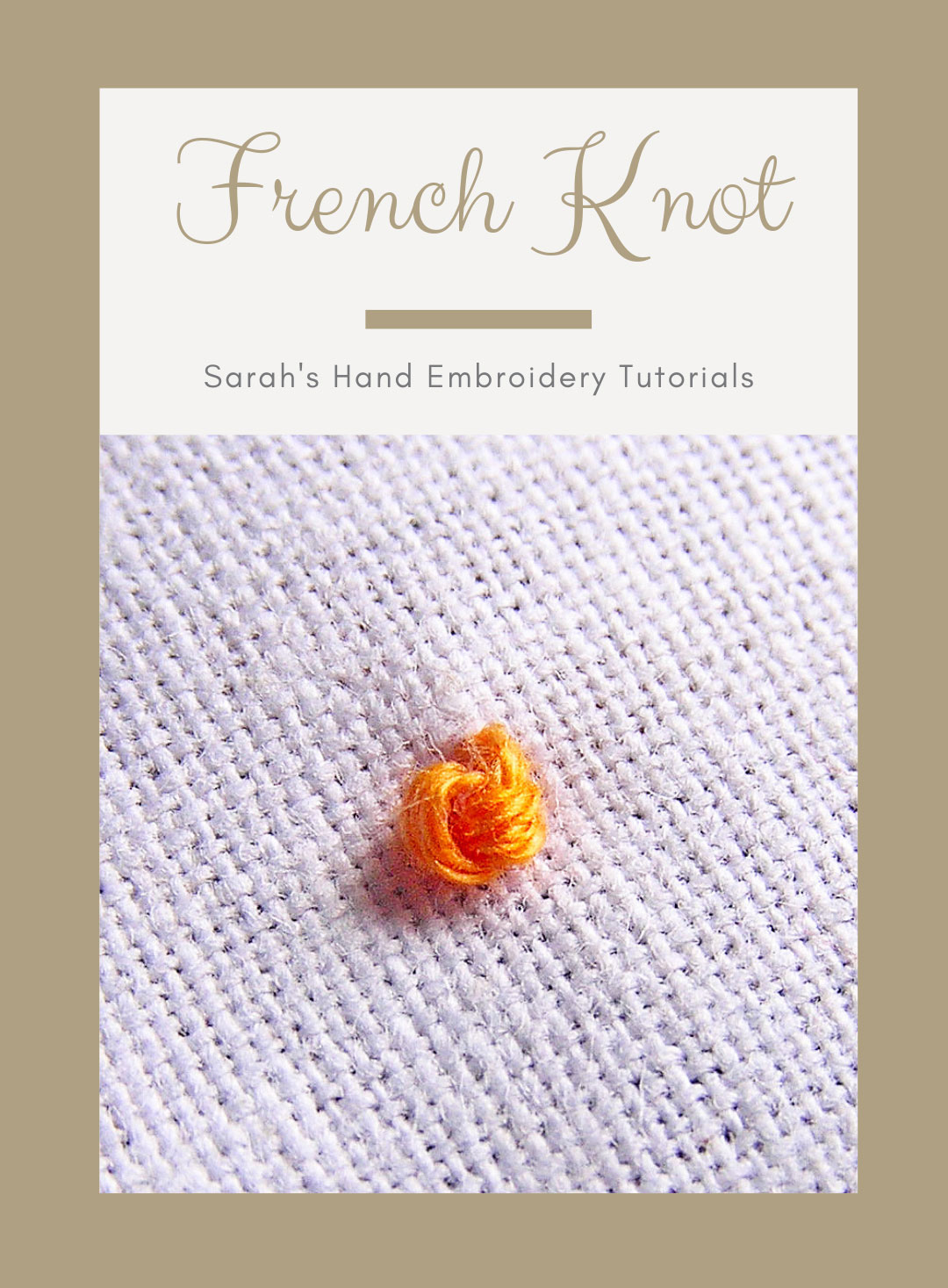
French knot is one of the easiest of all knots. Interestingly, however, it is often hailed as the one of the most difficult-to-handle or difficult-to-do stitches. This, so much so, that learners often end up hating to do this stitch. I personally feel it is one of the most creatively use-able stitches once learnt, and not much of a deal.
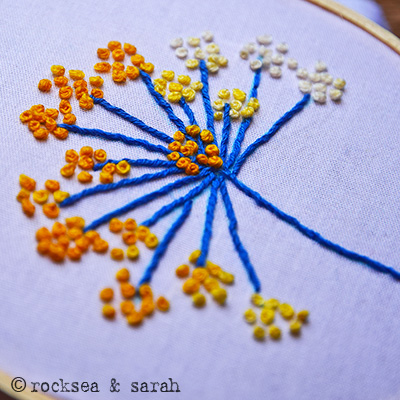
This stitch can be used to do little flowers, or as a filling stitch to fill in small circles and centre of flowers. Many closely done french knots can give a ‘woolly’ appearance and can be used creatively. You use both hands to do this stitch, so I would advise you read the instructions also to understand the illustrations.
Tags: embroidery tutorial, french knot, hand embroidery, knot stitch, knots, penny squares, redwork, turkey red embroidery


ohhh…reminds me of my school lessons.. i always had trouble getting this one proper…ur lessons do help me…
Yes, I had some trouble understanding the difference between colonial knot and french knot! It took me a little research to clear it out.
happy that this lesson helped.
Hurray I am so glad i stumbled upon your embroidery tutorials! Your stitch technique site is bloody brilliant, I love it!!! It has inspired me to get cracking with my Angel pictures! So a huge thank you from me!!!
Thanks Claire
Hi,
I have been looking all over the internet for toots as I (at 58…ugh) am just beginning to get back into embroidery. I have forgotten so much. I have two problems. One, no matter what I do, my attempts at a French knot, fail miserably; the floss pulls straight through….what is wrong? Two, how do you keep the back of your work “pretty”? All of my aunts (now in their 80′s) were taught the back had to be as pretty as the front and produced beautiful hand work! My pieces have backs that look like nationwide maps! Ugly. I don’t want to make constant “beginnings” and only stitching and inch or less at a time before color changes…so what to do? Any help appreciated!!
Dear Ruby,
Thanks for going through our pages.
The french knot: I cannot understand exactly why your thread is pulling straight through.
If it ‘coz your wrap of thread on the needle is coming out before you put the needle back in: You can try following the instructions in Fig 3. I can try to explain again if it is not clear to you.
If it is ‘coz you are pulling the thread too hard, that the knot goes through the fabric: Try using few more strands of threads to make it thicker and try not to pull the knot through too hard.
I can also suggest you to try some video tutorials, if it helps.
Keeping the back neat: Reversible forms of embroidery, like Blackwork, usually give techniques on how to ‘hide’ threads when we begin, end, or join. This not only keep the back neat, but many times, also similar to the front!
In many non reversible embroideries, the neatness of back is not stressed upon. But, you can try to keep it neat by:
1. Keeping your thread comfortably long enough, so that you don’t end up with too many knots behind the fabric. Try taking around 40 cm of thread. When you take it through the needle, it will half into 20 cms. Tie a knot at only one end and start stitching with one half of the thread instead of both halves. This way, you can stitch for a length worth 40 cm, while keeping your thread always at around 20 cm or less length.
2. When you carry the thread from one area of stitch to the other, make sure it is not carried for more than an inch. In cases, where you have to, it is always better to begin new.
3. While doing a stitch, learn how the back should also show up like. For instance, when doing the stem stitch correctly, the back should appear like a back stitch. Stitching correctly, can give you a prettier effect behind the fabric too.
Hope this information helps you in some way.
I admire you getting back to embroidery at this age.
yeah the more strand makes it worse im trying to use the best materials but nope
Dear Lola,
I hope you are using Milliner’s needle ( A type of needle that is of the same thickness throughout , even the ‘eye’ portion. This helps in avoiding any tension when pulling out the needle by passing through knots easily instead of getting stuck).
P.S: Sorry for a late response. I saw your comment only today.
I am looking for a way to do the French knot as a nose on a quilt and need to know how to start and finish it without ends showing.
Dear Pat,
I am not too sure if I know of a way to do french knot without the start and stop ends being shown.
Hi,
I’m trying to make small roses(scattered around my main work) with french knot. But the knots are awfully small and it just looks like a dot. Is there somehow I can make them look bigger?
Thank you
Dear Padma,
You can try using a thicker thread, like wool, to do the french knot. Or, try taking more strands of thread/ floss. I hope this helps.
Sorry that I am replying late…was on travels.
Which is the best needle to make french knots ??? When i wrap the thread and put the needle in the fabric it is difficult to pull the needle down the fabric.. may be because the end point of the needle is stuck
Dear Radhika,
It is best to use ‘milliner’s needle’ to make any kind of knoted stitch. Milliner’s needle has the same thickness all over, unlike the other needles that are a bit bulgy at the eye. If getting a milliner’s needle is difficult, try using a needle that is the least bulgy at the eye.
Sorry to respond late as I had been out on a month long vacation.
Dearest Sarah
A very good website, was looking for one like this. i would like to know what type of cloth you use for embroidery and cross stitch the what is the name of the cloth and where to get this cloth in kottayam since i am from thiruvalla but staying abroad. can you please let me know . so i can ask someone to get it for me
thankyou
Dear Anju,
Thankyou for showing interest.
Usually, you can use any simple cotton cloth for embroidery. For cross stitch, you can use an even weave cloth called ‘matty’. It has holes in between through which you pass the needle. You can ask for it in any cloth shop, though I cannot exactly point you to one. Since the demand for such cloth has gone down, you might have to search in a few shops before finding it.
Dearest Sarah,
Thankyou .
Do you get casement cloth for embrodiery in kottayam . one of my friends told me that to do embrodiery this is a very good cloth . Can you please tell me all the stitches you instructed here was done on what type of cloth .
Have you heard what is porcupine needle . Its used to make holes in the cloth .
It would be wonderful for you to print this into a book . Any day if you start classes on embroidery , i would love to join you once i am down for my vacation.
One more thing where can i learn to stitch salwars and blouses. I m looking for a person to teach me who know very well sewing. If you know let me know . It would be a very kind of you .
Thanking you once again
God bless you and your family
Dear Anju,
But we are right now based in Pune, and if you can make it till here, it will be a delight to have you as a student.
Sorry for being late to respond. I have been out of internet for a long long time.
Your interest in embroidery is totally appreciated.
Sadly, I am not too familiar with places in Kottayam, so cannot advise you about the shops there. But am sure you should be getting casement cloths in furnishing shops. It could be good for embroidery as it is an open weave fabric.
I have used a simple cotton cloth for illustrating the stitches.
I have checked on porcupine needles, and looks like it is a thick needle that can leave holes in the fabric. Not seen one in real though.
I have already started on some classes.
I can suggest you a place called ‘Kalagram’ in Pala (about 20 kms from Kottayam city). I feel they are good in teaching you stitching and embroidery too.
Yes, we had been planning to get a book published, but it might take a little time. A demnad from you really gives us a push to work faster towards it. Thanks.
Enjoy stitching.
This sounds wonderful, and I thank you for the instruction. However, how can I do a French Knot and the Outline Stitch on a crocheted afghan with the Afghan stitch as the background? Thank you very much.
Dear Lynn,
Thanks for dropping by. Honestly, I have never tried stitching on a crocheted afghan. So, explaining to you how to do it might be even difficult. Yet, let me try my best.
Assuming that the crocheted afghan is closely knit, your afghan should look more or less like an even weave fabric.
Doing the outline stitch over it is easy, by bringing out and taking in the needle between adjescent threads. A french knot can be done similarly with a thick thread, and gently, by bringing out the needle through the gap between two threads, and taking in the needle through the gap between the top thread and the thread above it, settling the knot on the thread in the middle.
I hope this explanation has not left you lost, but has given you some idea.
Dear Sarah,
Awesome!! Your embroidery tutorials helps me a lot! I can do an individual french knot and bullion knot, but i have no idea about the pattern using these knots. Can you give me some individual designs or patterns in french knot and bullion knot. I’m eagerly waiting for your reply…
Sri
Dear Sri,
Thanks.
I am sorry that I am yet to put up patterns that students can use for practicing stitches. While we hope I can do it as soon as possible, let me suggest you some ideas.
You can use french knots to fill in the centres of flowers. They can also be used as flowers: combine them with any of the feather stitch family members for the stems. You can use bullion knots as petals of flowers.
You can also refer to a small sample I had put up here: http://www.embroidery.rocksea.org/stitch/knots/
See how the bullion knots have been used as the petal outlines and french knots have been clustered on top.
I hope this gives you some idea. Best wishes.
How can I make it bigger?
Try using a thicker thread.
I don’t think there is any other way to make it bigger.
hello sarah,
I am very much impressed when I saw your site.You have done a great job.Basing on your explenations I have prepared a notes also.I am willing to do embroidery but I am a housewife and I have two kids one is 4yrs and another is 9months old so I can’t go any where you solved my problem thank you so much.
regards,
revathi
Dear Revathi,
With a 3 year old and a 6 month old myself, I can only understand how pressed on time you are for various activities. So, we are only glad that you found our pages to learn from.
i need help what is the thread you used
You ROCK! Thank you so much for all the information on your site. I want to teach my grand daughters how to stitch and you’ve covered all the basics and more. Thank YOU very much!
Thank you for the tutorial! I’m a bit embarrassed to admit, but I have always hated French Knots because they never turned out right. So still to this day I complete all my stitching and then take my projects to my mom to make the French knots for me.
) Maybe now I will have better luck and make my own!
Like said, Marisa, French knots can be a challenge and drive you crazy. You can see some earlier comments here, where readers ask for help. But, it is only practice and getting the knack of it that can do the trick. You should certainly keep trying patiently…am sure you will get it.
Great websites . Merci beaucoup
um you know the thread you use to do the french knot what is it called because my thread is to thin and it wont happen so i would like to know what thread you use please tell me asap i need to know so i can to my assignment which is due in 2 days
I have used all the 6 strands of cotton floss in this illustration. You can use a thick perle cotton too.
hi and i just want to thank you for all of this because i usually did not like stitching but your website totally inspired me so thank you:)
I have been cross-stitching since Preschool (about 25 yrs) and have always hated french knots. I’ve always passed my work off to my grandmother or mother to finish these dastardly knots. I am currently working on just a small little cross-stitch snowman with six knots on it. I left them until last and found your tutorial tonight. First try after looking this over and finally a nice french knot! Thank you very very much! I can’t wait until my next project now to do more french knots!
Hello, tring to find a stitch call lace lock, for hiding ending knots, or hiding end of work, could you show diagram? Thank you