
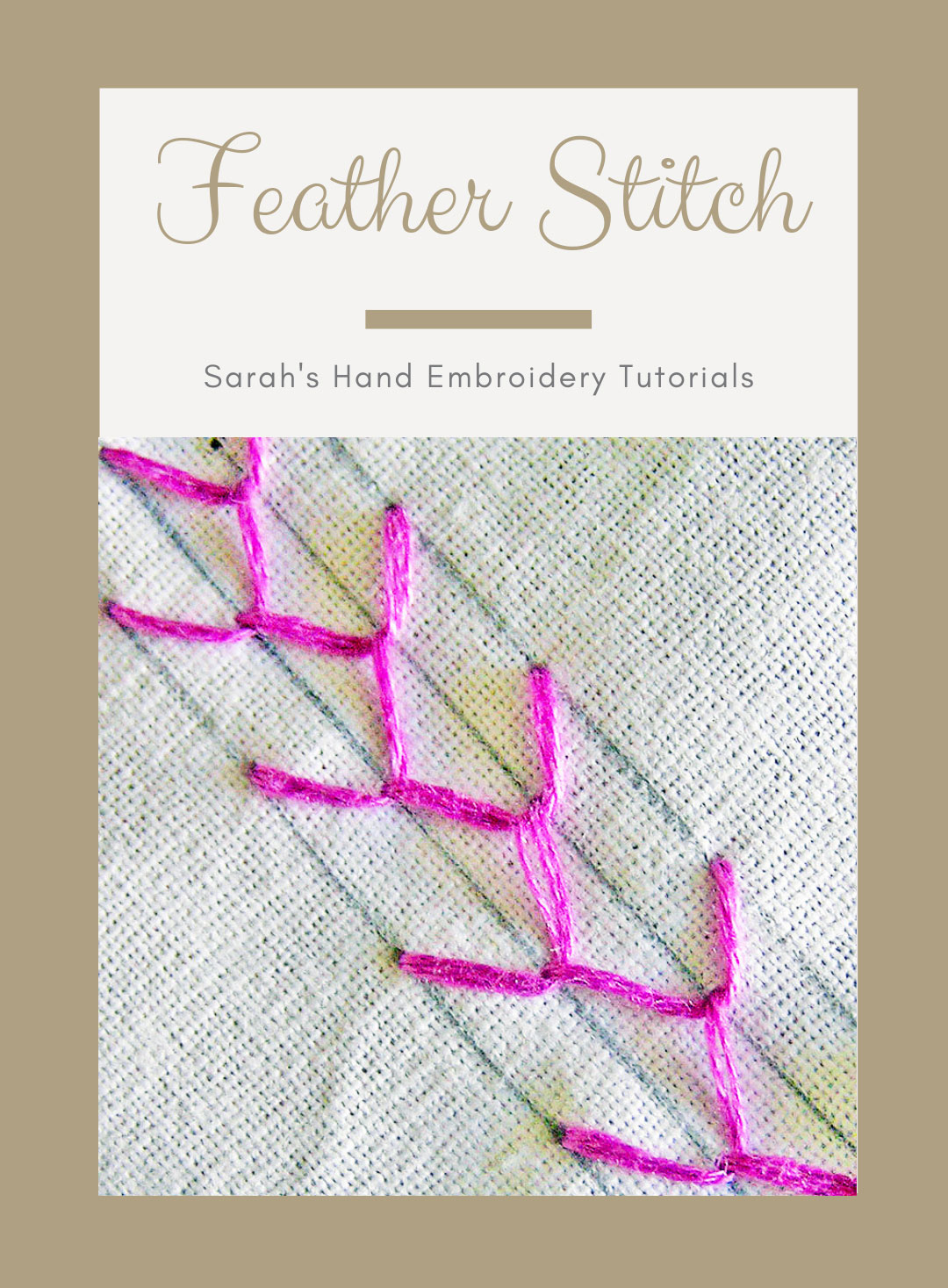
Feather Stitch is also known as
Punto de pluma [ES], Point d’ épine [FR], Federstich [DE], Punto corallo [IT], Ponto pena simples [PT], kråkspark [SV].
How to do the Feather Stitch
Feather Stitch is a decorative stitch, usually, used to accompany it with embellishments or other forms of stitches like the French knot. This stitch can be used liberally to make beautiful borders, horizontal or vertical fillings, or even designs with curves. It looks like a series of interconnected ‘V’s.
It is always advised to make stitch lines to avoid any asymmetry. I have made four parallel stitch lines, A, B, C, D. The stitches will fall between these lines and the needle will pass through these lines.
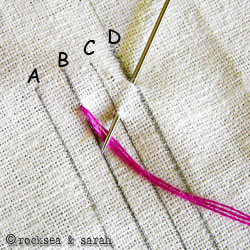 | 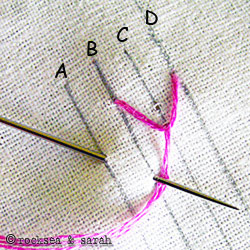 |
| Fig 1: Begin by bringing up the needle from B. Now, put the needle in through D and bring it out from C. Note that the points on B and D falls on a straight line, and C lies diagonally to both B and D. Pull the needle out with the thread under it, as shown. We would form our first ‘V’. | Fig 2: We now move to make our next ‘V’. Continue to put the needle in through A and bring it out through B. Pull the needle out with the thread under it as shown, to make the next ‘V’. |
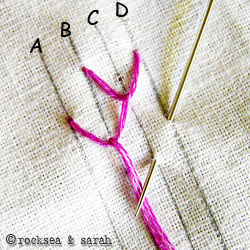 | 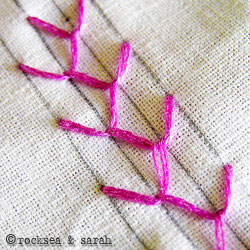 |
| Fig 3: Now, continue the procedure by putting the needle in through the outer stitch line and bringing it out from the inner stitch line. We keep alternating between the left and right side to make the ‘V’s- putting in the needle through A and bringing it out from B; putting the needle in through D and bringing it out from C. | Fig 4: Once a small portion of the Feather Stitch is done, this is how it would look like. |




This is a great website! The instructions are very clear.
Thank you, Anne! So happy that you like our website!
Jjmon Ang gabasa
I doubled crocheted a sweater; and found I needed to put a liner, if you will, inside. I found the feather stitch to assist me with it and I wanted to say thank you for putting your own site together. It’s amazing👍 I forgot about all the stitches. Happy memories
Thank you, Sunshyn. I am so happy that this page helped you. 🙂
thank you sarah, i’m improving my stitches
I am happy to know, Fiona. We would love to see some of your work. Please share them here! 🙂
Thank you so much! Is there a way to make this wider? With 8 or 6 points instead of 4?
Yes! Just add 2/4/6, parallel lines on either sides and add the stitches on the sides.
sarah
i nitted my grand son a sweater thank you
That is great, Sharol. Please do share pictures of the sweater if you can. 🙂