
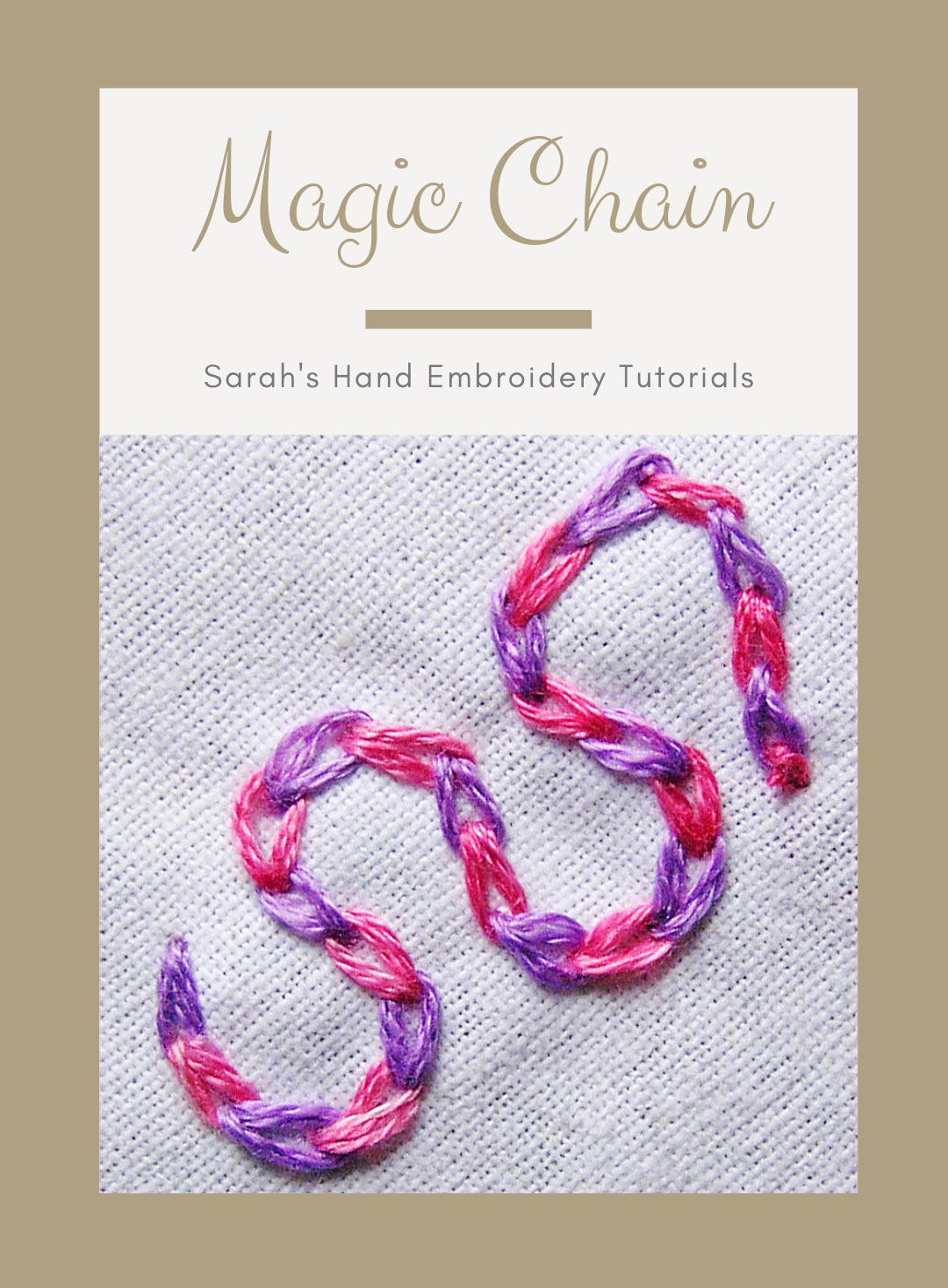
Magic Chain Stitch is also known as
Chequered chain stitch [EN], Cadeneta bicolor / Cadaneta mágico [ES], Point magique / Chaînette magique [FR], Magischer kettenstich [DE], Ponto de cadeia xadrez [PT].
How to do the Magic Chain Stitch
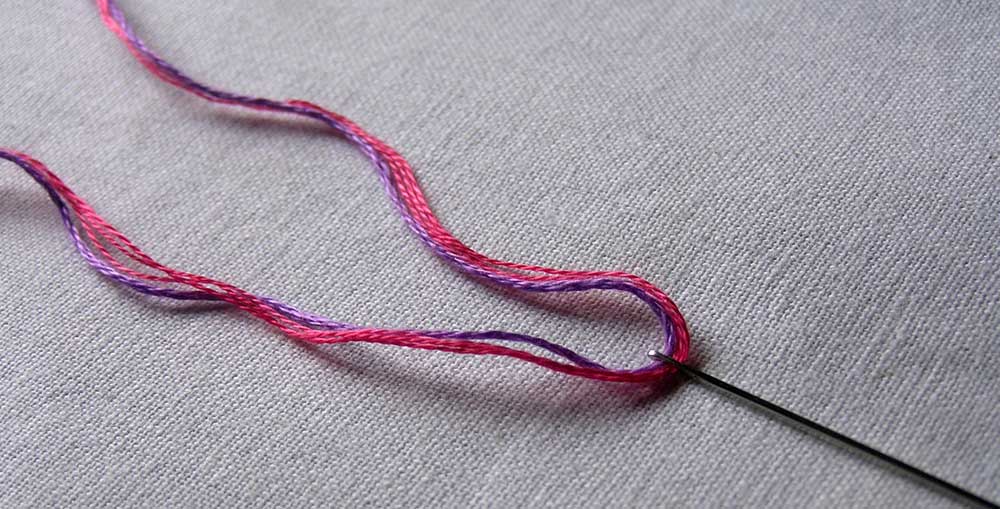
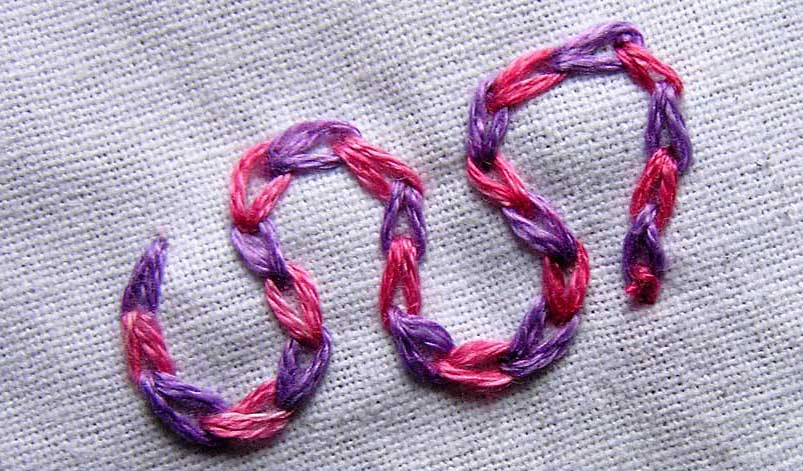
This is a little tricky for the first time doers. So be careful not to twine the threads too much in the process, and keep slow pace and patience. Magic Chain Stitch is a wonderful stitch, which uses two (or more) colors alternately to form the chain sequence. You need to know the Chain Stitch to be able to do this. I will be working over a curvy stitch line with three strands of pink and purple threads each.
 |
|
| Fig 1: Use two colored threads of equal thickness and pull it through one needle. | |
 |
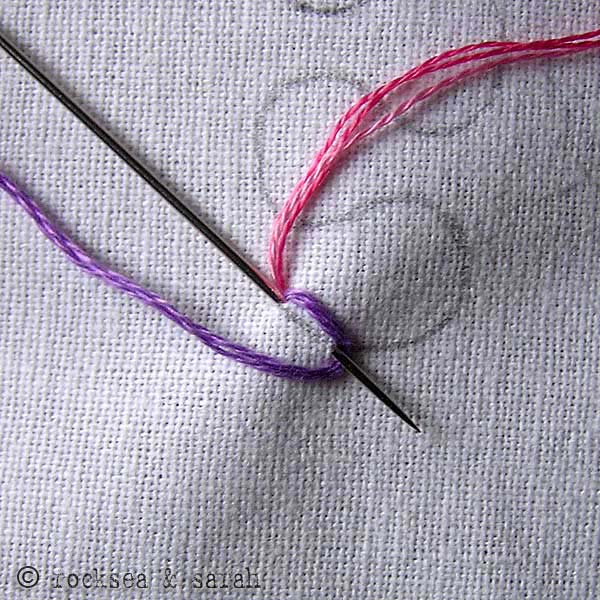 |
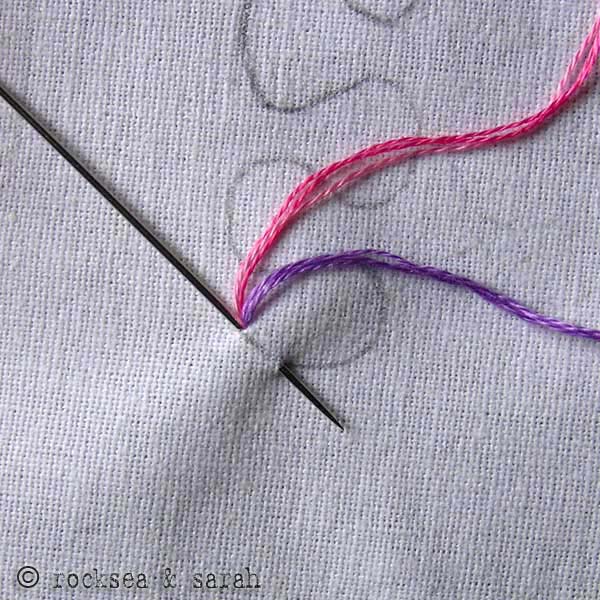
| Fig 2: Since this follows the chain stitch procedure, position the needle the way we would in chain stitch, as shown above. | Fig 3: Now, loop ONLY the first color of thread around the needle. I have looped the purple thread first. |
 |
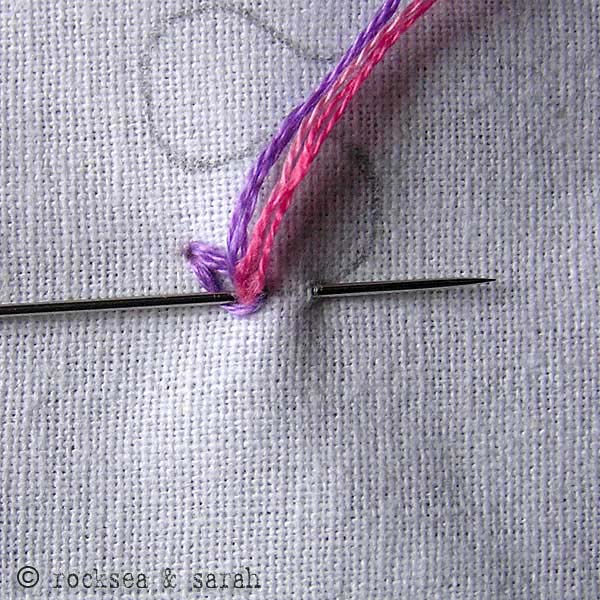 |
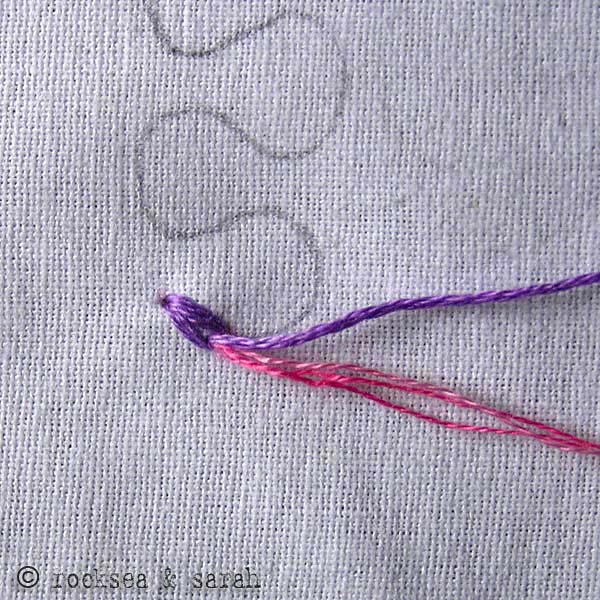
| Fig 4: Pull out the needle to get one loop of the first color. | Fig 5: Now, put in the needle for the next loop, as we would in chain stitch. |
 |
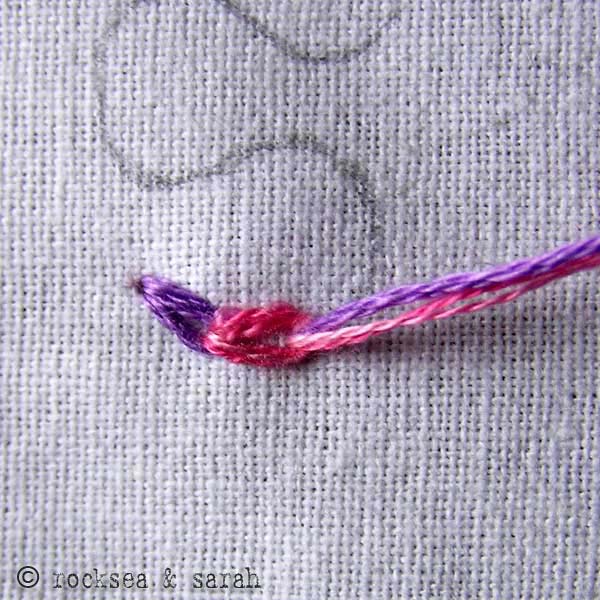 |
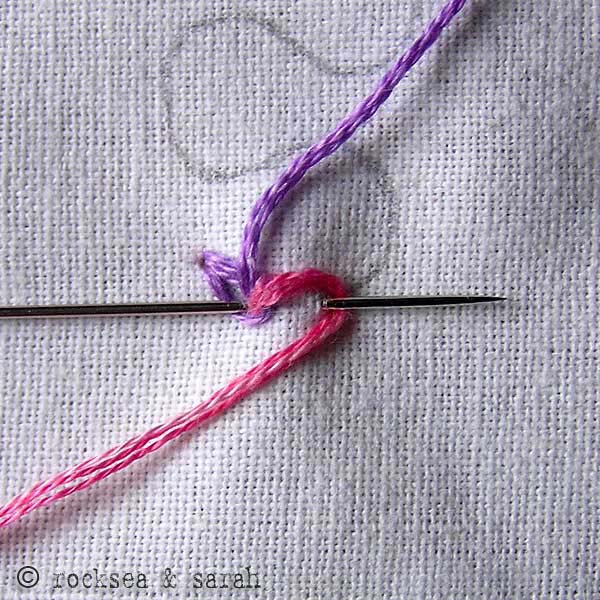
| Fig 6: Loop around the second color this time. | Fig 7: Pull out the needle and you will see a loop of the second color. |
 |
|
| Fig 8: Continue the process of this chain stitching, looping each color alternately, to get a pattern like shown above. | |
 Sarah has been researching and sharing hand embroidery lessons for over 18 years, making it accessible to everyone around the globe.



My magic chain stitch motif
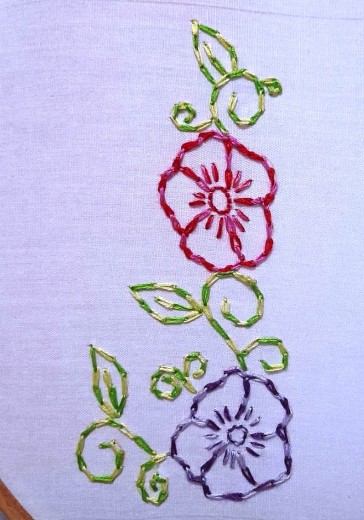
Magic Chain Stitch requires patience for some, especially when done for the first time. This pattern has come out so well!
Love it! 💜
Thanks! 🙂
How how do you join more floss to continue the chain?
Hi Theresa,
End the last chain by anchoring it down with a small stitch, as usual.
Next, come out with the fresh thread from inside the last chain. Now, you would continue stitching the Magic Chain as usual- take the needle in through the last chain (not exactly through the same hole that you brought the fresh thread out from), and come out outside the chain to make the next chain.
Ensure you are looping the correct color while continuing.
I hope this helps. Let me know! 🙂
Very clever. Enjoying your website very much.
Hi I am learn hand embroidery
thank a lot it help me in my project it is more creative thx a lot .. 🙂 (y)
Thanks a lot for your best site.
Hi ! Sarah ! Great work! I am a beginner and even my daughter took interest on working this after seeing your blog. We both will practice. Thank you!
hi sarah,
can you tel me which stiches are used in banjara or rabari embroidery…..like filling flowers etc please
WOOW, ME ENCANTA FABULOSO GRACIAS
Dear Sarah,
The Stitch are very nice and useful… You are excellent my tutorials.
Thanks for sharing this.
am getting confused wid this stitch …. can u send me some clear pics of how ur doing it or some videos plz ????
its very useful…. thank u mam
This Is Amazin Stich
amazin
Wonderful job Sarah, even I am a beginner,and your site is a big help and is of equal interest.
Hi sarah,
I found your website yesterday. Felt very happy, finally found what i need to learn. I’m very new to do embroidery. pls help me what types of needles. threads and materials to use.how to use them too… And your pictorial illustration are very helpful to learn quickly. Kindly pls reply…..
Dear Sarah,
Thanks for sharing this. Very good idea .
Dear Sarah
Thanks
I worked this magic on my kurti and the result was amazing.I stitch ladies outfits and worked on other kurti as well.Sharing the pics along. THANKS A LOT

Hi Gurmeet.
Thanks for sharing a picture of your work. You have used three colors for magic chain in a neat way. Really nice! 🙂
It’s very nice
I just have to say, all of your tutorials are wonderful. They have been the most helpful compared to the other tutorials I’ve observed. Thank you so much 🙂
I love your tutorials! I’m wondering what kind of thread you use. I’m usually only able to afford the cheap stuff from Michael’s, but since it tends to unravel pretty easily I want to occasionally spring for a slightly better quality thread. Thanks!
Dear Alie,
Here, in this post, I have used cotton floss (3 strands each). I usually use Anchor cotton floss. If you check the ‘chain stitch family’, I have used perle cotton. It is non divisible, but comes in various thickness. You might want to use perle cotton for some embroideries as they have good sheen and are easier to work with. 🙂 Hope this helped.
I would like to know the stitches used in banjara embroidery with the designs. I hope I will get a positive response to this.
Hello Varsha,
I am working on some banjara embroidery and patterns…I might upload something on mirror work and kutch work next time, but hope you will bear with the time it takes.
Excellent work Sarah. Keep it up!
Dear Sarah anty,
this stich is veryyyy beautiful !!
Dear Sarah,
You are doing a wonderful job. Keep up the great work.
🙂 Thanks Janaki.
Dear Sarah,
The tutorial is very good. Keep up the good work. have a nice day!
🙂 Thanks Sandhya.
Hi sarah,
fantastic, I should say for a beginner like me I could u/stand every part of the tutorial. Great work! Keep up the good work .
Very very interesting. Thank you so much !
Dear Sri,
It is wonderful to have comments like yours. Our pages were created especially with total beginners like you in mind, and words like these from you makes us happy and our work worthwhile. 🙂
Hi Sarah,
Why don’t you have videos for tuff stiches? It would be more helpful.
Nandhini
Dear Nandhini,
Your idea to have video tutorial for tough stitches is good. However, right now, we will be working only with picture tutorials. Every effort is being put in to make it as simple and easy as possible. We also welcome suggestions and corrections that would help to make the tutorials much simpler, even for total beginners. 🙂
I much prefer photo tutorials to videos. Photo tutorials I can look at and work on while having a conversation or watching TV, or just when I need to work in silence. I don’t need to pause or try to find the exact frame that represents where I went wrong. I can print it for reference. It’s very convenient!
I’m learning to embroider for my Halloween costume and I really appreciate your site. Well done, clear, and beginner-friendly, and there’s a nice variety of stitches here, too. I love it!
WOW!!!! So beautiful 🙂
Excellent tutorial
preeta
indeed its magical….simples strands of thread giving beautiful shapes to our vivid imaginations…:))
well, i have one more name for this particular stitch coz of resemblance…’Dragon Stitch’…hehe
i think the dragon look is cuz of the design, and not the stitch!
why magic? due to alternating threads appearing in the stitch?
yes! it is quite ‘magical’ to see that you get alternate colors for each loop. It gets more interesting with more number of colors. 🙂