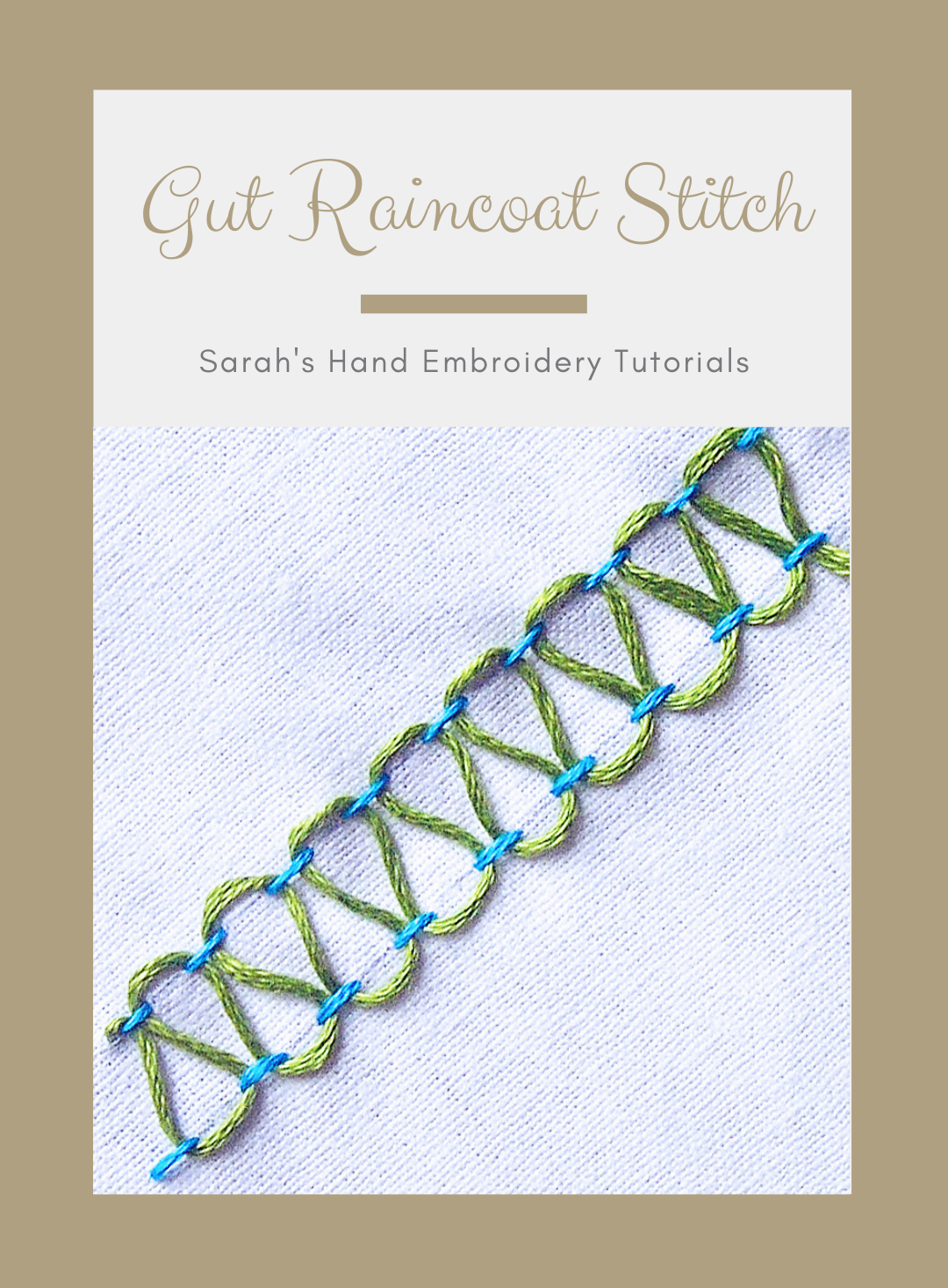
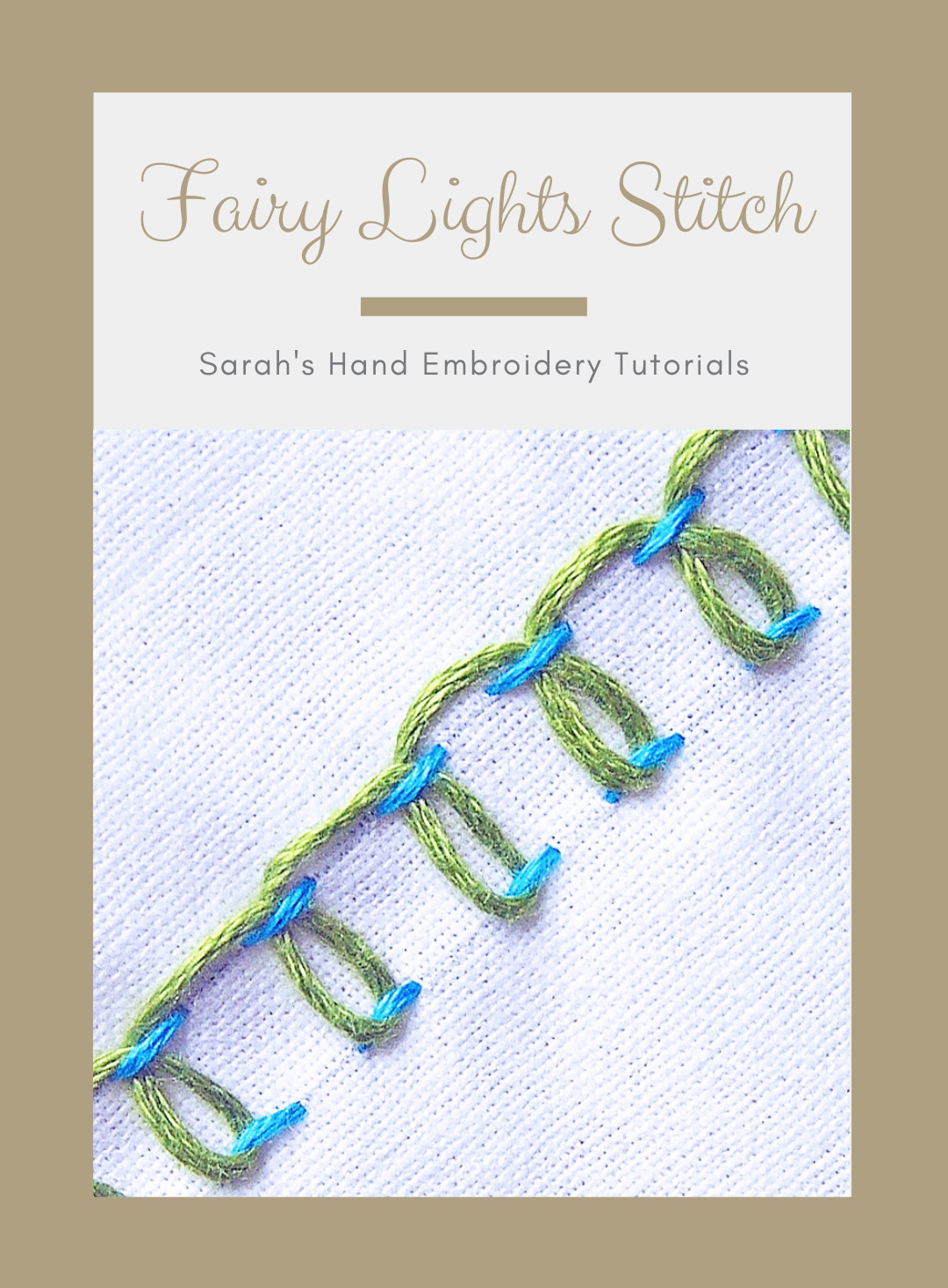
This lesson will demonstrate how to do the embroidery using the different stitches over a border design.
It is advised to go through the thread-fabric-and-stitch section of the chicken scratch page before beginning this lesson. It will help you to understand the logic and techniques used in this embroidery.
The stitches used are mentioned with each illustration. Clicking over them will take you to the instruction page of that stitch.
![]() |
![]() |
|
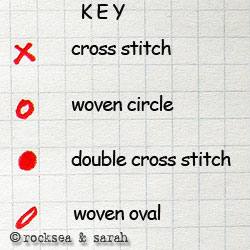
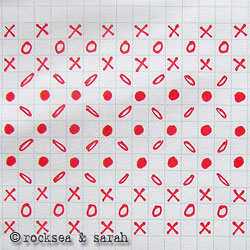
| This is a broder design. I want it to have a very lacy effect, and so, will use two strands of thinner perle cotton thread. The key will help me to decode the stitches onthe graph and use them on the gingham cloth. Each cell in the graph is like each cell on the cloth. | ||
![]() |
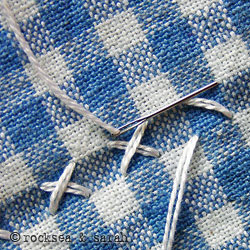
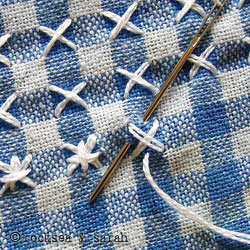
Cross stitch: It is always better to begin any design with the outer stitches or outlines. So, I begin the border design by doing the cross stitch. I will be doing the cross stitch over the darkest cell. |
|
![]() |
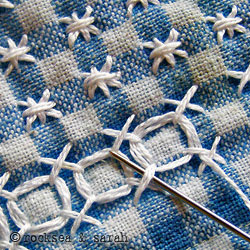
Double cross stitch: I begin filling up the inner part of the border with the double cross stitch. The filling is done only over the darkest cell. |
|
![]() |
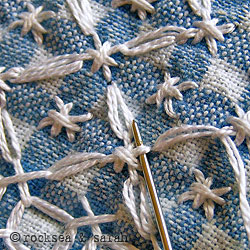
Woven circle: The legs of the cross stitch provides good anchors to make a woven circle. I make two rounds of circle, each time. This gives a bolder, more embossed look. |
|
![]() |
Woven oval: I weave ovals with the diagonal stitches of the double cross stitch as the anchors I make the ovals only in the white cells. |
|
![]() |
||
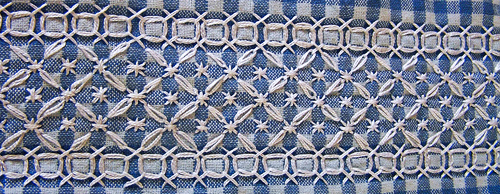
| The finished border looks like this. It gives a very lacy and rich effect when viewed from afar. Note how all the tinted cells are left alone. Working the cross and double cross stitches over the darkest cells nullifies the color in the design part of the fabric. Woven ovals and woven circles over the white cells, amplifies the ‘whiteness’ and gives it a more raised, lacey look. The tinted cells will throw out a background effect. |
||
Tags: amish embroidery, chicken scratch, depression lace, embroidery tutorial, gingham, gingham lace, hand embroidery, snowflaking, tic tac toe embroidery


Hi sarah,
This question might sound silly. I’m sorry if you have explained about the threads and needles that can be used for each stitches(for better look). Also, I’m in India Chennai, can you advise any shop which can provide all these threads. As many of the crafts shop have only Anchor thread six strands tread.
Please……..
Nandhini
Dear Nandhini,
I do not know much about the shops in Chennai, so I don’t know how much I can help you with it.
If you can check in any store that sells art and craft items, or even tailoring items, you can at least find some information on where you can find a thread store. Most of these stores usually have anchor threads, silk threads and perle cotton (one which I used here).
Thank u
Nandhini
Hi Sarah,
Thanks a lot for the tutorials. Please tell me whether this stitch can be used in plain cloths.
Dear Lekshmi,
This stitch is traditionally meant to be on gingham/ checkered cloth. You can also try this on aida/ matty cloth.
This kind of embroidery had been developed to make the checkered cloth look more attractive. But, there is no rule that you cannot try this on a plain cloth.
There is always a scope to experiment.
So, if you are trying it on plain cloth, and if you feel good about the outcome, please share your work with us by uploading a picture of it here. It will be an inspiration to many.:)
hi Sarah,
I’ve almost seen all the types of stitches you’ve given a tutorial on but I am really not understanding that which one should apply on a CASEMENT cloth. So I would be really very thankful to you if you tell me which embroidery should i use
Dear Muskan,
Since casement cloth is similar to an aida/matty cloth, the threads is easily countable. So, you can use the stitches you can use over aida fabric. For instance, cross stitch family of stitches, the running stitch, back stitch and many of the chain stitch family of stitches. In embroidery, you can try chicken scratch, kasuti work, cross stitch, pattern darning varities etc…
Hope this helps.
Hi Sarah,
Just came across ur page while browsing for craft ideas. U have an awesome site and this page inspires me to start embroidery once again after ages. I love how u illustrate every stitch and the tutorial is easy to understand.
I have also come across so many new stitches which I was not aware off, but your tutorial makes it look simple and urging me to try
Will dfntly dig in for my needle and thread this weekend and will post you what i make out of it.
Till then, thanks for putting up such a fab site.
Cheers.
Dear Chetana,
It is indeed nice to know that our pages have inspired you back into embroidering.
Yes, please do share with us what you will be stitching. It will be nice to see.
You have nice website and I am wanting to try out many of the recipes from it.
I am just recovering from my post delivery condition and will get back to my kitchen slowly.
warm regards.
nice work sarah
are you on facebook??
love your work ..
regards,
sana
Pakistan
Ohhh very interesting lesson! do existe a lesson 3 and 4 and more?
kisses
Manu
Hi sarah, interesting work, I have tried this work; link is here please go through
creative-patterns.blogspot.in/2012/08/trial-chicken-scratch-embroidery
Dear Sunayana,
Thanks for sharing your work. Really nicely done. Please try to upload a picture of your work here too. It will be interesting.
Thank u sarah…I ve uploaded image of work I tried
Thanks Sunayana for sharing here. It will be an inspiration and example to the other learners.
Its my pleasure sarah… Its glad to follow ur blog
iam posting algerian eye sampler here..
Hi Leela,
Thanks for sharing your work. It is nice to see a variety of this stitch.
i tried to upload my chiken scratch work again and again here but not succeeded yet..dont know whats the problem..thank you sarah for the support..
Hi Leela, there is a file size limitation of 5mb. Please check if that is the case. Otherwise, send the file to sarah by email.
Cheers,
Hi Sarah
i must sincerely commend yo for doing such a good job with this blog, I went through each and every stitch, although I myself don’t do much sewing now, used to when my girls were younger. used to make handbags, purses and baby bags, now got on to cakes and fruit carvings, i do sew my own clothes and add on embellishments to them. that’s how I stumbled into your blog, while searching for Zardozi tutorials, i once got a book from mahila arts with zardozi designs, and treasure it. all the best Sarah! you are such an asset to people out there who want to learn these stuff. keep up the good work!
God Bless!
Its very nice sarah. I have learned a lot from ur site. even i have to thank u for allowing for copying the steps for learning the stitches, where none does in their blogs, which will help me even if i forget the steps…. thank uuuuuu.
For synthetic sarees what type thread should i use….?pls reply
Dear Suvarsha,
Thanks.
The type of thread to use on synthetic saree depends a bit on what kind of synthetic saree it is. Generally, I would suggest to stick to 2 strands of cotton thread or silk threads if the saree is a thin one. If the fabric is thick, then, you can use any thread.
Felicitaciones por el arte maravilloso que tienes en tus manos! Y gracias por compartirlo! Saludos desde Argentina!