
Climate Change and Hand Embroidery
Stitching a Greener Future: Hand Embroidery as a Voice for Climate Change
Climate change isn’t just a headline—it’s a lived experience that’s becoming harder to ignore. We feel it in the air, in the seasons, in the news of fires, floods, and vanishing forests. It can feel overwhelming, even helpless at times. But as artists, makers, and storytellers, we do have a voice. And sometimes, that voice comes through the simplest of tools: a needle and thread.
Hand embroidery may seem like a quiet craft, but don’t be fooled—it carries incredible power. It gives us space to process, to speak up, and to connect with others in meaningful ways. As the world speeds up, embroidery slows us down—and in that slowness, something powerful happens.
Embroidery as Expression
There’s something deeply personal about stitching. Each needle prick is a moment of attention, each thread a thought made visible. Through embroidery, we can tell stories that matter—stories of our changing world, of the heartbreak and hope woven into it. Many embroiderers, including me, have found ourselves drawn to climate themes. We stitch melting glaciers, cracked earth, rising seas and endangered animals. One image I’ll never forget was that of the bleached coral reefs, which I embroidered onto a canvas—vibrant on one side, bleached and ghostly on the other. It is to serve as a haunting reminder of what’s happening beneath the surface. In fact, the Great Barrier Reef, along with coral reefs around the world, has suffered repeated mass bleaching due to rising ocean temperatures, even as recently as early 2024.
Our stitches can bring these hidden crises into the light. They make the invisible seen—not just for ourselves, but for everyone who looks at our work.
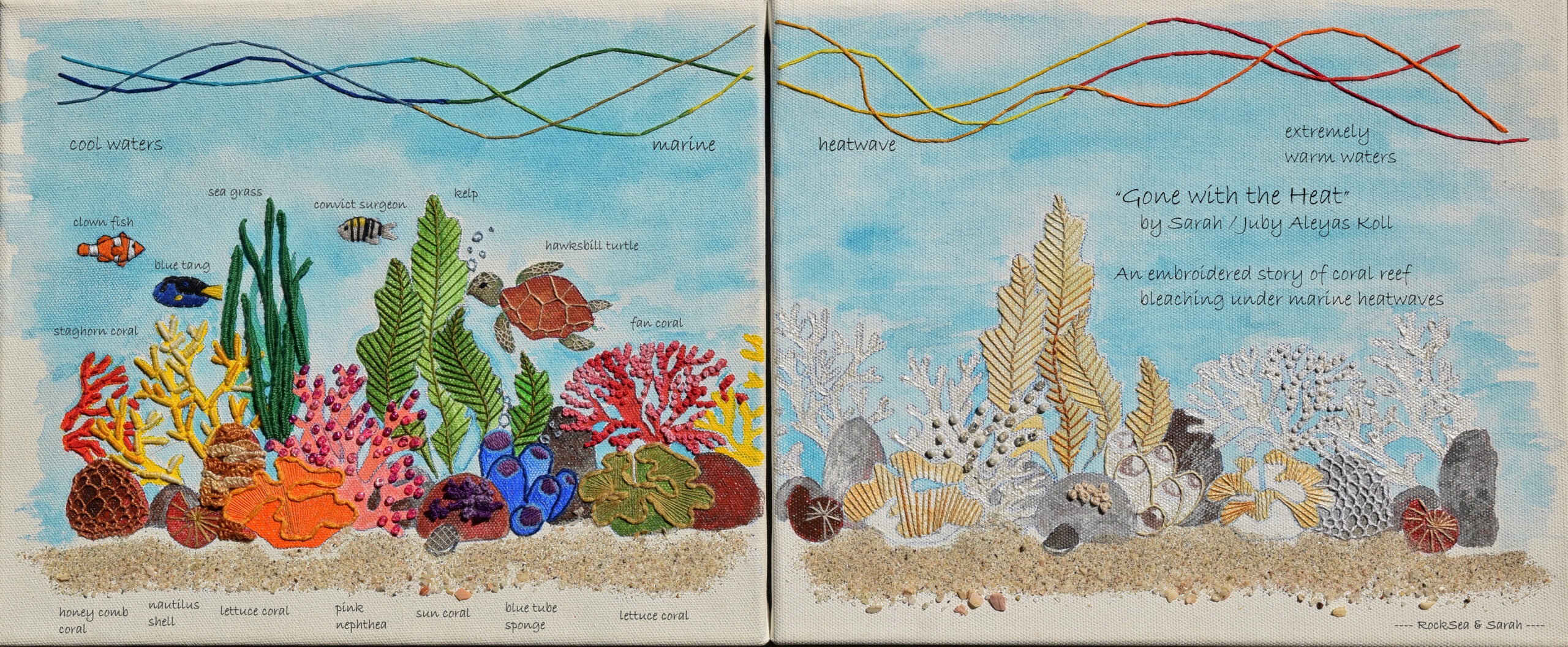
“Gone with the Heat”, an embroidered story of coral reef bleaching under marine heatwaves. Artwork executed by the Kolls and exhibited @ the International Indian Ocean Science Conference 2024, Lombok, Indonesia. Learn more about this particular piece of work.
Embroidery as Education
Embroidery can teach. A single embroidered piece can spark curiosity and invite conversation. Schools, museums, and climate-focused exhibitions are now embracing textile art as a tool to raise awareness. With messages stitched in bold threads or delicate images woven through cloth, embroidery transforms complex, overwhelming climate science into something tangible, digestible, and deeply human. Workshops that combine embroidery with environmental education give people a chance to learn with their hands and hearts. By stitching symbols of endangered ecosystems or embroidering climate pledges, participants begin to internalise the message—and often, carry it forward into their lives.
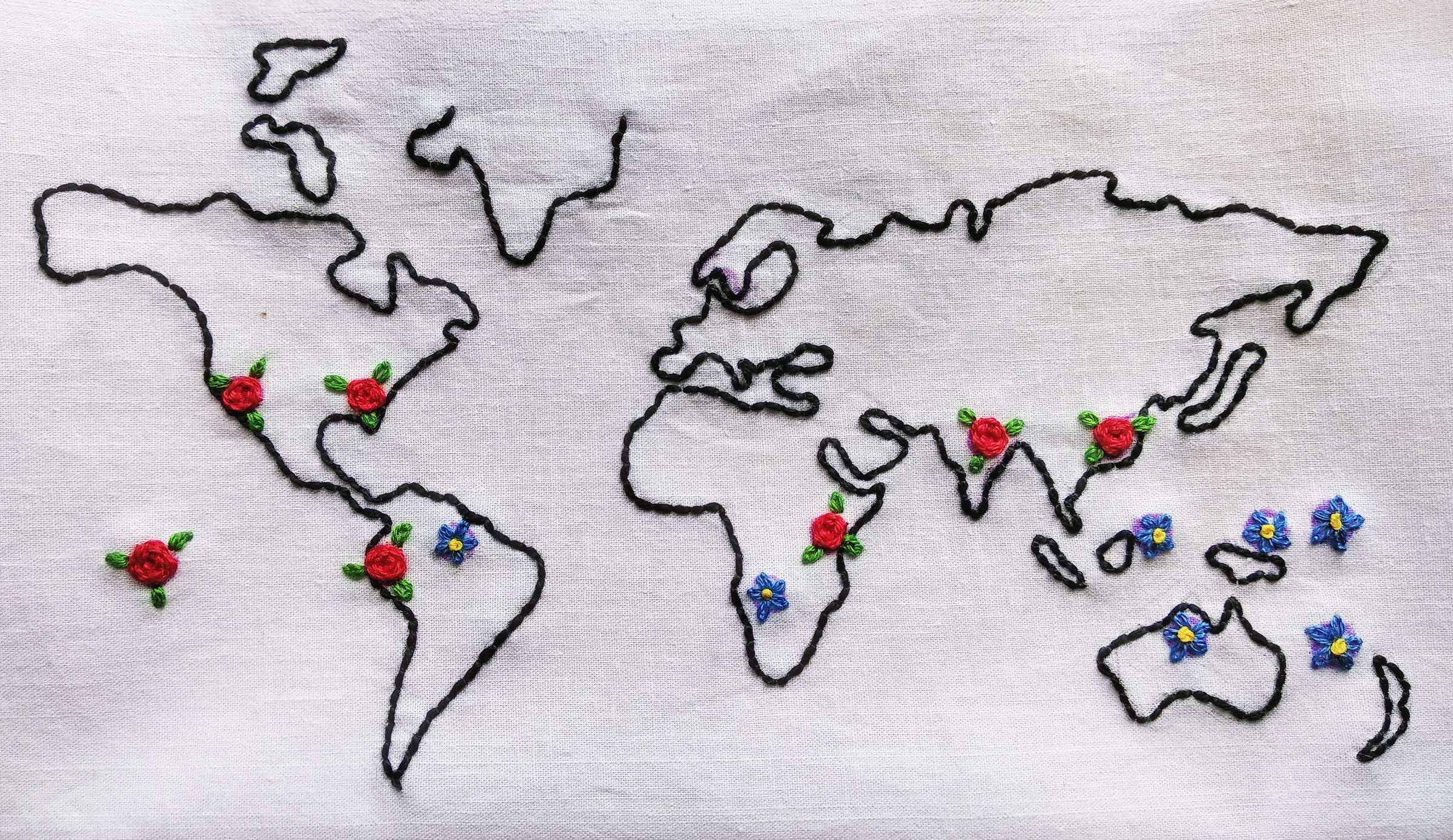
This piece of embroidery symbolically shows that extreme events have increased due to changing weather patterns around the world. The red roses show a rise in heat events and blue forget-me-nots depict an increase in wetter phases. This study was published in the journal, Nature. Use the Stitch Dictionary to pick your stitches and create your map of changes!
Embroidery as Activism
Some of the most powerful protests I’ve seen have been through art. Quietly, persistently, it makes its point. Artists are creating embroidered banners, patches, and garments that demand attention—and demand change. It’s soft, yes, but not silent. A community can come together to remind itself and the world, through ongoing art activity, that the picture is not looking good, and we need to protect the place we live in. Even the way we stitch can be a form of activism. Many of us are embracing low-waste practices: using thrifted fabric, naturally dyed threads, or scraps from past projects. We’re choosing to create mindfully, with the Earth in mind. It’s a small but meaningful rebellion against the throwaway culture around us. When we choose sustainable materials, we’re not just making art—we’re making a statement.


This is an ongoing embroidery where each stitch denotes the climate anomaly for a particular year, starting from 1850. It symbolises that the climate is spiralling out of control and you can see more red stitches on the outer edge. Know more about how to start your own ‘Temperoidery’.
Stitching Towards Change
Hand embroidery won’t stop wildfires or cool the oceans overnight. But it can shift perspectives. It can heal, educate, provoke, and inspire. And when stitched together—when shared in communities, exhibitions, and conversations—it becomes a quiet force for good.
Across the globe, climate-related disasters are hitting harder and more often. In 2024 alone, Southern Europe faced blistering heatwaves, the US battled record wildfires, and millions in South Asia were displaced by severe floods. These aren’t just stories—they’re lives. And they need to be told, again and again, in ways that people can feel.
That’s where we come in. As stitchers, artists, and caring humans, we have something to offer. Every piece we create, every message we share, is a thread in a larger tapestry of change.
So here’s my question for you:
Are you using embroidery to express your love for the Earth, your worry, your hope?
If yes—share your work. Talk about it. Invite others in. Let’s stitch a better future, together.
XOXO
Sarah
 Sarah has been researching and sharing hand embroidery lessons for over 18 years, making it accessible to everyone around the globe.



Querida Sarah, hace un tiempo descubrí tu sitio investigando sobre el trabajo Kantha y me quedé en él, no sólo por tu valioso contenido, tu espíritu didáctico sino porque comparto contigo la convicción de que el bordado auna espíritus, generaciones y da voz a las preocupaciones y sueños de cada bordador. Gracias por tu aporte, yo también estoy diseñando un tapiz sobre un tema ambiental, es mí forma de conversar con el mundo. Un abrazo fuerte desde Argentina.
Dear Laura,
Thank you so much for your lovely message. It truly made my day! I’m so happy you found my site and connected with it. I completely share your feeling that embroidery has this quiet magic and brings people together, bridges generations, and lets us express what words sometimes can’t.
Your tapestry on an environmental theme sounds beautiful and deeply meaningful. I would love to see what you are working on. Please feel free to share a picture or two of your work here.
Sending you a big warm hug all the way to Argentina,
Sarah
dear Sarah I am always following your tutorials for my embroidery. My comment is not about love of earth. Although i am working on an aerial embroidery right now. I am commenting because i was looking for “Quaker stitch” in your website. But I didn’t find it. Could you add a tutorial of this stich please. Your tutorials are really great and easy to follow. Thanks a lot.
Hi Tahera,
Thanks for dropping by. I had received this request before, too- I will make a tutorial for this stitch and get it ready, hopefully by next month, as I have a lot on my plate right now. 🙂
Thanks a lot