Posts Tagged 'stem stitch family'

japanese stitch

Posted by on 11 Oct 2010 | Category:

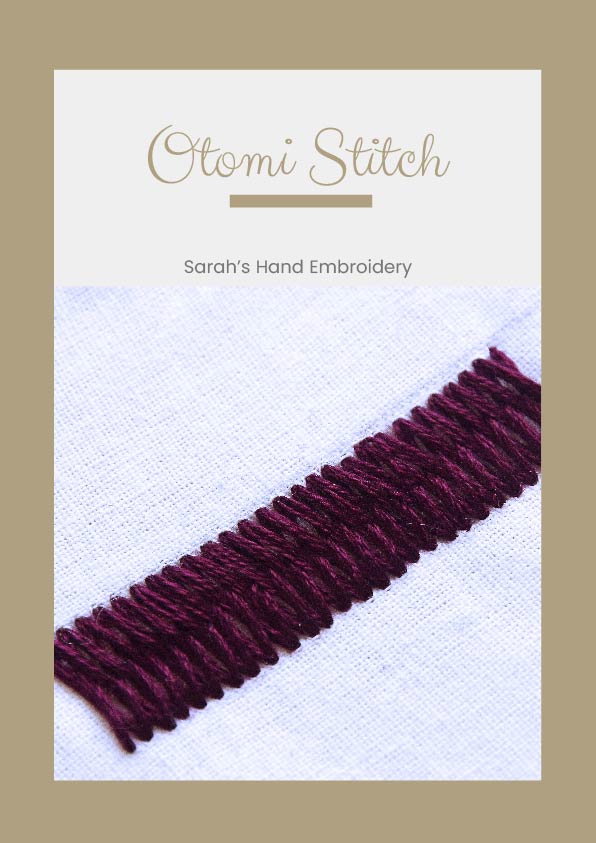
This variation of stem stitch family looks like satin stitch. The technique used is that of outline stitch, the only difference being that every successive stitch is made within a short gap difference. The tutorial will make it clearer to you.

I will work on an open space to demonstrate this stitch. This stitch cannot be carried out like the other stem stitch varities, in a straight line. Japanese stitch can be used for simple fillings of geometrical nature. It is generally used to depict larger areas of landscape like, water.

japanese_stitch_1      Fig 1: Bring the needle out through A. Now, put the needle in through B and bring it out through C.This process is similar to outline stitch. Only, make sure that C lies at a closer distance to A, and not exactly between A-B like it would in outline stitch.
     
japanese_stitch_2   Fig 2: Continue this process of stitching.
     
japanese_stitch_3   Fig 3: A finished series of this stitch would look like this. You will see that though it uses the outline stitch process, it looks like satin stitch.

portuguese stem stitch

Posted by on 04 Feb 2010 | Category:

This stem stitch looks sophisticated after being completed. It is not though. It follows a simple stem stitch technique with a little extra loopings between each stitch.

I will work on a slightly curved stitch line to demonstrate this stitch to you. You need to know the stem stitch to be able to do this stitch.

portugese_stem_stitch   portugese_stem_stitch_ 2
Fig 1: We start with a single stem stitch. Bring the needle out through A, take it in through B and out through C.   Fig 2: Now, take the needle under the stitch A-B without pluckign the fabric beneath. Make sure the needle comes out from the left side of the point C, as shown. This makes a loop around the stitch A-B.
     
portugese_stem_stitch_ 3      portugese_stem_stitch_ 4
Fig 3: Make another similar loop around the stitch A-B, keeping it towards the left of the previous loop. So, we get two loops.   Fig 4: Now, make the next stem stitch. After making both loops, continue to take the needle in through D and bring it out through E. Then, make the two loops. Make sure the loops encircle both A-B and C-D.
     
portugese_stem_stitch_ 5   portugese_stem_stitch_ 6
Fig 5: Half way through, our portugese stem stitch would look like this. It gives out a complicated look.   Fig 6: A full curved stitch line woud look like this. Observe how the stitch shows up at the two curves.

coral stitch

Posted by on 09 Sep 2009 | Category:

Also known as: German knot, Snail trail

This stitch is done from right to left. The knots fall in between a trail of straight stitch. This stitch can be used for various different types of embroideries, especially in making stem patterns.

I will be working on a curved stitch line to show the flexibility of the stitch.

coral stitch 1   coral stitch 2
Fig 1: Bring out the needle out from A. Put in the needle through B and bring it out from C, both which lie on either side of the stitch line.   Fig 2: Loop the thread around the needle as shown.
     
coral stitch 3   Fig 3: Pull out the needle and you will see a knot formed. continue with the procedure of making knots.
     
coral stitch 4
Fig 4: A completed line of coral stitch would look like this. It gives a feeling of a thread docked down with tiny stitches. :D

split stitch

Posted by on 31 Mar 2009 | Category:

This is a very old stitch which is used for outlining and also for filling in colors for patterns.

Looking back into the history, Split stitch has its popularity placed at a high during the medeival ages in England. The needle work of this times was called Opus Anglicanum.This medeival english needlework comprised of generous use of split stitch for fillings in a motif along with ‘underside couching’ method of embroidery. It covers the whole cloth on which it is worked and leaves negligible space for background. So, we can say that the history of split stitch is akin to the history of Opus Anglicanum.

Origins
Opus Anglicanum was done mainly for the purpose of the rich and powerful churches of the medeival ages. Though it was used otherwise too, only a very few of its kind has survived. Information has it that they were mainly done by nuns or anyone with a seven years of apprenticeship in a secular workshop. It was also populary done among the Anglo-Norman ladies. This was a time when embroidery work was viewed as a highly skilled art work at par with other art forms like stained glass work, sculpture, architecture and, silver and gold metal work. In fact, it was considered to be of a higher esteem than fine art.

Popularity
This embroidery was done with fine silk and gold threads. Not only was it done with expensive materials, but it was labour intensive as well. This made the garments very expensive, so much so, that it went on to become a status symbol for the religious leaders and royalties. From the mid 1200s to mid 1300s, the fine embroidery of England was exported all over Europe and Opus Anglicanum was at its height. Great profits were made by the merchants who hired labourers for this expensive embroidery work. However, the great value of these garments also led to its destruction. When the older garments wore out or was no longer in use, the gold threads and other expensive embelishments would be pulled out and used in new creations. Opus anglicanum used exceptionally high quality materials and was done by highly skilled artisans.

Decline
The decline of Opus Anglicanum was seen from 1348, after the Black Death. The country saw a general unrest with a high decline in population. The time was ripe for newer techniques and materials to invade the textile and embroidery scene. Materials from Italy were used and embroidery work reduced to just borders or applied peices. Weaving took more importance than embroidery. Cheaper and quicker ways of stitching embroidery came into being. Satin stitch, brick stitch, long and short stitch, surface couching and stem stitch slowly replaced the tiny and laborious split stitch.

Instructions
Now let us get on to our lessons. :)

split stitch 1     split stitch 2
Fig 1: Bring out the thread out through A and put it in through B   Fig 2: Take the needle backwards to bring it out through C. Note that C lies half way between A and B.
     
split stitch 3   split stitch 4
Fig 3: While bringing out the thread through C, take it in between the thread, splitting it into two.   Fig 4: Again, put the needle in through D to bring it out through B, splitting the thread.
     
split stitch 5
Fig 5: Continue this procedure to finish the stitch.The only thing to keep in mind is to split the thread when bringing the needle out. In some way, it will give you a visual feel of chain stitch.
 
split_stitch_6
Fig 6: The reverse of the fabric will give you a back stitch pattern.


Note:
Since I have taken 6 strands of thread, I have taken care to split them into three each. But I suppose that as we move on to using split stitch for more elaborate designs, we can be leniant with splitting the thread into exact halves. Well, this tip is for the more lazy ones. :D
Rows of split stitch used in close succession can be used to do filling for a design. It is a laborious task, but when done with patience can create beautiful fillings.

outline stitch

Posted by on 24 Mar 2009 | Category:

As the name suggests, this stitch is used to mark outlines in an embroidery pattern. It is a flexible stitch that can follow easy curves. In looks and procedure, it is only subtly, but importantly different from the stem stitch. Please follow the instructions of both the stitches carefully to study the differences.

To make the logic clearer, I have drawn a temporary stitch line with a pencil. Now, note that all the stitch points in outline stitch will fall ON the stitch line. I will be working this stitch from left to right. This instruction is for right handed learners.

outline stitch 1         outline stitch 2
Fig 1: Bring out the thread through A and take it in through B. Take the needle backwards and bring the thread out through C. Make sure the point C lies under the stitch A-B.    Fig 2: You need to note that the point C lies about half way through A and B. Also note that C lies under the stitch A-B. 
     
outline stitch 3
Fig 3: Take the needle in through D. Try to mark D in such a way that the point B will lie half way through C-D. Bring the needle out through B. The stitch point B will be at the bottom of the previous stitch.
     
outline stitch 4
Fig 4: Continue this pattern of stitching with the needle coming out from the bottom the previous stitch always.
 
outline stitch 5
Fig 5: The reverse of the fabric will give you a back stitch pattern.

NOTE:
So, the unique feature of outline stitch is that, when you work from left to right, the needle and thread will be brought out from the BOTTOM of each previous stitch. In case you work from top to bottom, the needle and thread will come out through the LEFT side of each previous stitch.
If we follow a pattern where the stitch comes out through the top or right side of the previous stich, it becomes a STEM STITCH pattern. Keep this in mind, and you will have the logic! ;)
The subtle visible difference between both stitches is that in a stem stitch, the separation between the stitches are more visible than what you would see between the stitches in an outline stitch. 

Older Entries »