Posts Tagged 'hand embrodiery'

fishnet stitch

Posted by on 28 Jan 2013 | Category:

This is a very nice looking and interesting filling stitch. As the name suggests, the filling would give a fishnet appearance. The fish net is created without touching the background fabric, while pinning down only on the sides. This stitch is ideal for fillings that need a netted appearance.

You need to know the blanket stitch to be able to do this stitch.

fishnet_stitch_1      fishnet_stitch_2
Fig 1: To begin with, make a foundation row of blanket stitch.   Fig 2: When you reach the right end of the row, we get ready to make the fishnet. For that, take the needle in through B and out through C, a point little above B, as shown. The stitch A-B will pin down the last blanket stitch to the side.
     
fishnet_stitch_3   fishnet_stitch_4
Fig 3: Now, we work a blanket stitch row from right to left, taking in through each blanket stitch of the previous row, as shown. Do not pluck the fabric beneath.
For some, it might be easier to work the balnket stitch upside down than to work from right to left.
  Fig 4: When you reach the end of this row, take the needle in through D and out through E, as shown. This pins down the second row on the side. 
Then, work a row of blanket stitch from left to right. Keep up with this procedure of working blanket stitches back and forth.
     
fishnet_stitch_5   fishnet_stitch_6
Fig 5: When you reach the last row, finish up by stitching a row of blanket stitch through the fabric, as shown. Through the stitching, you will find the fish net crunching up. Don’t worry, when you finish, the last row of blanket stitch will pull up the fishnet to shape.   Fig 6: The fishnet would look like this.

algerian eye stitch

Posted by on 11 Jul 2012 | Category:

Also known as: Star stitch, Algerian eyelet stitch

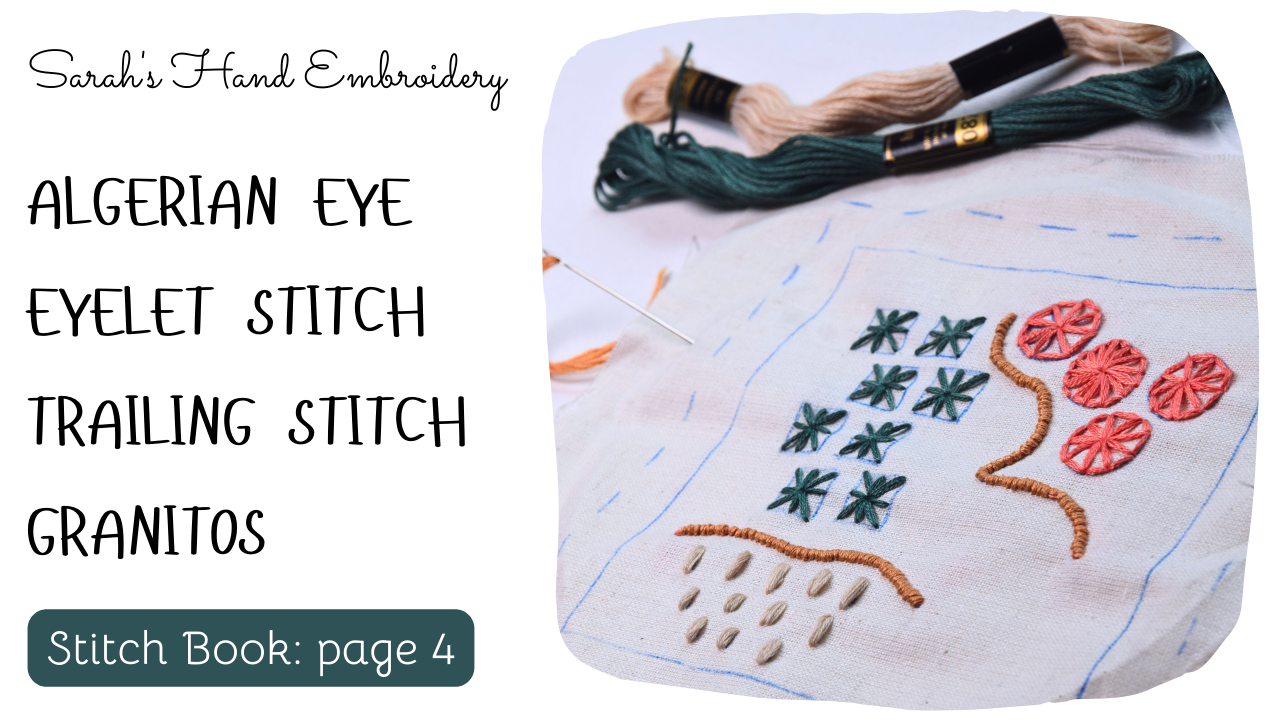
This stitch combines atleast eight straight stitches to form a star like pattern inside a square area. The Algerian eye stitch can be used as a filling stitch on even weave fabric in a wonderful way.

You need to know the straight stitch to be able to do this pattern. I will work within a roughly made square area to illustrate this stitch.

algerian_eyelet_stitch_1    algerian_eyelet_stitch_2
Fig 1: Bring the needle out from A, a corner of the square. Take the needle in through B, the middle of the square. Again, bring the needle out from C, a point that lies half way of one of sides fo the square, as shown.     Fig 2: Now, continue the sequence of bringing the needle out through the corners and then through the middle of the sides, each time, taking it inside B. Work this all around the square.
     
algerian_eyelet_stitch_3    Fig 3: The algerian eye stitch would look like this. You may add more spokes or straight stitches, but in even numbers, to get a more filled algerian eye. The minimum spokes you would want is eight, as shown here.
     

straight stitch family

Posted by on 24 Jun 2012 | Category:

This is probably, the first stitch you need to know before learning any other embroidery stitches. It is a simple single stitch done by taking the needle in and then out of the fabric. Most stitches begin by making a single straight stitch. Apart from that, many straight stitches can be combined in various ways to come up with various patterns.

A series of detached straight stitches form the running stitch. So, I have mentioned and shown the running stitch family as a member of the straight stitch family.


barb stitch

Posted by on 08 Mar 2012 | Category:

This is a decorative stitch using two rows of blanket stitch. These two rows are made as mirror images and later whipped together.

You need to know the blanket stitch to continue with this tutorial.

barb_stitch_1     barb_stitch_2
Fig 1: Make a row of blanket stitch. Turn the fabric around and make another row of blanket stitch just adjacent to the previous row, as shown. The two rows should look like reflections of each other.   Fig 2: Now, come out with a contrasting colored thread and whip around the stitches of both the rows, as illustrated.
     
barb_stitch_3   Fig 3: A finished portion of the row looks like this.